“Don’t fear failure. — Not failure, but low aim, is the crime. In great attempts it is glorious even to fail.” – Bruce Lee
The quote above from Bruce Lee may seem a little intense for an introductory culinary class practicing eggs over easy. I can assure you, failure is painful in all its capacities. When it is something you care about, something you love, something you want, all failure hurts. And when the failure is small and persistent, there is an extra layer of shame. “This is easy,” I kept screaming to myself. “Just DO it! Everyone is doing it! This simple, simple thing!” What inevitably happens once I start talking to myself like that is continued failure. Despite my internal desire to veer into this self-flagellation, it has never ever worked to correct my actions. The same was true in class.
We began the day with brown stock. The difference between white and brown stock is that white stock places bones (usually chicken or fish) directly into boiling water, while brown stock roasts the bones (usually veal or beef) first. If I thought 20 pots of white stock was incredible, the smell of roasting veal bones was another level. The air felt rich but still light. Brown stock also sautes the mirepoix first, which creates a delicious caramelization to the vegetables.
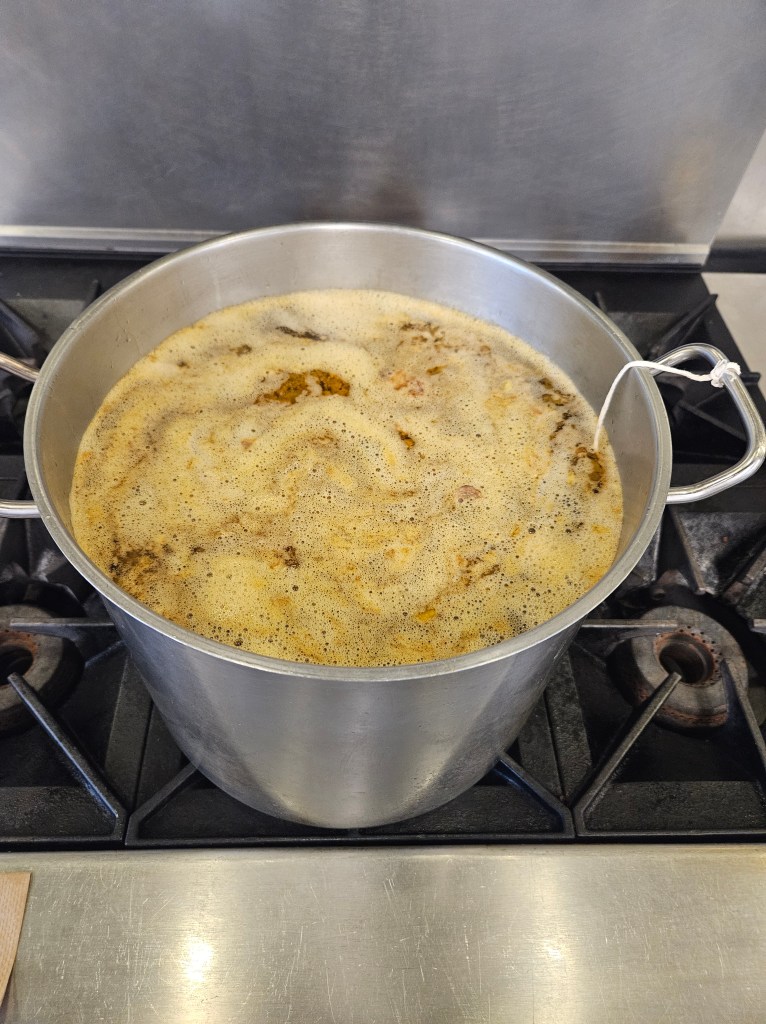
We prepared one pot as a table, which made me nervous. But, the students in this class continue to impress me with their positivity and professionalism. Working together with two strangers around steaming bones and sharp knives was shockingly smooth. The kitchen is a loud place, where communication matters above all else.
“I’ll grab our bones, you get started on the herb sachet, and you prep the pot on the stove. Is that okay?”
“Mary, can you check my mirepoix?”
“Behind!”
“Sharp, corner!”
“Hot pan!”
“Someone’s is boiling over! Table Three? I’m turning it down!”
Still riding high from last class’s encouragement from Chef, and buoyed by a great start to the class, I was excited. I had also practiced eggs over easy and over medium all weekend. My partner loved over easy eggs, so I felt like a star bringing plate after plate for breakfast and dinner, watching them cut into steamy whites and seeing that perfect, custardy yolk spill out. I was here to nail it.
As Chef began his demo, my heart started to flutter. Oh, we’re doing two eggs? Hmm, okay, that shouldn’t be too bad. And they have to be flipped. Okay, I knew that. I practiced. But he seems to be going into a lot of depth explaining what to do when the eggs break (“Flip over the stove, not the floor. The burners are easier to clean than the floor.”) He also asked for two people to a stove, if possible. That day, I was the only table of three. My classmates encouraged me to take the third burner, that they would make space for me, but I got flustered. Chef then told me to just use his station. His station. Where Chef cooked all his perfect eggs. With the camera directly above me. Broadcasting my eggs to every screen in the classroom. I will fully admit, this moment is when I started to sweat.
In gathering my tools, I realized my second mistake (the first being only practicing with one egg). I practiced using my home pan. I had forgotten my school pan in my locker and figured it was no big deal. It was, in fact, quite a big deal. My school pan was thicker, newer, and of better quality. It weighed about three times as much as my home pan. Double shit. But there was nothing I could do about it now. I warmed up my pan on the massive burner, added some oil, and began.
Why so many eggs on the syllabus? Eggs are deceptively difficult to make correctly and consistently. They are all about temperature control and attention to detail. Chef expected our eggs to be cooked evenly (not one yolk different from the other), with absolutely no browning, and as few bubbles as possible. I decided to aim high with what I knew and go for the hardest one first: eggs over easy. I started well. My temperature was good. The spatula felt like an extension of my hand as I delicately pushed the edges from the side, loosening up the whites so I could swirl them. As they started to set, I knew this was the moment. One flip attempt and my wrist froze up, so they barely even hopped in the pan. I looked at the clock (mistake) and realized I was getting behind schedule. The other terrible thing about my location was that Chef was seated to my left reviewing the eggs. That meant Every. Single. Student. walked by me with their egg plate – really driving home how slowly I was cooking. I decided to just go big and jerked my wrist. The eggs hit the edge and yolk splattered everywhere. Ok, I prepped my other eggs, so I had two more ready to go. I wiped my pan, oiled and started again. Perfect cook again, destroyed on the flip. Great. I went for a third time and about 75% of my eggs landed well, the other 25% flopped sadly on top of themselves. I quickly adjusted them with my spatula, seasoned them, and slid them onto a plate. Finally! My work was good, but my whites were not as set as they should be. I’LL TAKE IT!
I had a new problem, though. I had prepped three sets of eggs and used them all. That meant while my classmates still cooked away, I needed to run to the fridge, grab more eggs, crack them into their respective containers, wash my hands, and return to the stove. Precious minutes slipped away. The students and the eggs just kept coming. A few made encouraging small talk with me while they waited in line for Chef’s review. I just kept breaking them. By the time I came to my final set of eggs, I gave up. I tried a flip, failed, and then quickly broke them up to cook as over hard. Most of the students were completely done and moved onto cleaning. One joked with me about watching me flip and cheering for me. (Remember, I’m also literally being filmed while cooking). I plated my sad little eggs over hard, which were okay but not quite up to snuff (over hard eggs need to have fully cooked yolk set hard with no bright yellow, of which I had a few spots). Chef was generous: “If you don’t eat eggs over hard, it’s difficult to cook them. And who wants over hard anyway?” Despite his politeness, I was crushed. I still had a huge mess to clean up, while my peers had moved on from cleaning their personal dishes to the classroom.
Each day, we are responsible as a class for scrubbing and sanitizing the kitchen lab, resetting it to its original state. The different tables have tasks assigned to them that rotate each week.

As I started cleaning my own dishes, I realized I was also now not helping my tablemates as they performed our group duties. I felt like such a loser. Oldest, slowest, my first zero in the class since I never got to over medium eggs, and I can’t even keep up on dishes. A final blow was when I emerged from the dish pit to see a fellow student cleaning my eggs off the burner (my responsibility). When I went to talk to her, she told me I had left a burner on – a huge safety issue. She was kind but her reprimand to “Be more careful” hurt. She could have told on me to Chef (and been right to) and I would have lost more points for the day. She told me quietly, just between us. It was a classy move on her part, but I was lower than low, disappointed in myself in a way I hadn’t experienced in years. My optimism was gone. As we finished cleaning, and Chef gave general notes for the day, I felt my chest tighten. He explained what the assignments were for next week and what to expect in the lab. I tried to focus. I clung desperately to the threads of my growth mindset. “You’re not going to be perfect every day.” It wasn’t that I was trying to be perfect at all. I realized I was comfortable with learning as long as it mean I did “okay” to “well.” Today had been bad. I did poorly and was ashamed of it. More than the grades itself, I felt like a burden to my peers. I had not done my part. I had even put them in danger.
I made it to the car before the tears fell, which was perhaps my only win of the day. As I drove home, I thought how stupid it was to cry over eggs. But, here I was. Last place, with yolk stuck to my clothes, my fingers burning, and feeling completely ancient. I texted some friends when I got home and received nothing but positive encouragement. It took about a day or two to recover. I was embarrassed, but I knew that recovery was what mattered. Not every dish required that cursed flip. Next week was chicken. Chicken is kind, right?
 Tiger Tail Kitchen