Week Nine: Summer Soups

“I tried to explain to Nami how much it meant to me to share food with her, to hear these stories. How I’d been trying to reconnect with memories of my mother through food…but I couldn’t find the right words and the sentences were too long and complicated for any translation app, so I quit halfway through and just reached for her hand and the two of us went on slurping the cold noodles from that tart, icy beef broth.” – Michelle Zauner

Michelle Zauner’s Crying in HMart is a love letter to grief, her mother, and ultimately food. The quote above describes eating naengmyeon with her aunt in Korea after the passing of her mother. I envy my fellow students who have stories of cooking at a young age with parents or grandparents. I envision the smells floating around them like a cloud as they work together to build a delicious meal. Laughter amid the sounds of thunking knives against wood and bubbling liquid. Maybe the occasional curse word as recipes come together or not. Lessons learned and handed down like heirloom jewelry and treasured maybe even more. A piece of jewelry is static. Food cooked together is living connection that transcends time and space. When you cook a recipe you inherited from a loved one, they are with you every time you make it.

My childhood relationships with food and cooking were not like that. My parents divorced when I was very young, so I grew up in two diametrically opposed and equally unhealthy kitchens. In my mother’s house, food was a reward for labor. If you were hungry, you ate what was placed in front of you, regardless of temperature, texture, flavor, or personal preference. It was also intimately linked with punishment. My sister and I were often sent to bed without supper or forced to finish our plates to prove a point. I remember complaining about the texture of some strange mix of canned vegetables (corn with…tiny bell peppers? Some odd early 90’s “medley”) and being locked in the pantry until I finished an entire bowl of it.

My father’s house balanced extreme over-indulgence with scarcity. A young single father who grew up as a spoiled only child, he had no real caretaking experience for young girls. We ate when he was hungry and at places he liked: fast food joints, late night diners, and all-you-can-eat buffets. After such strict restriction at my mother’s house, my sister and I went nuts during our time with him. We gorged ourselves on everything we couldn’t readily identify on menus or icy steel bins, from shrimp cocktails to patty melts to Caesar salads. We often made ourselves sick. He also would eat only 2 meals a day, skipping breakfast for massive piles of food at mealtimes. He did not cook and kept no food in the house, so whatever my sister and I could get when we ate out was it for the day. When I got older and started carrying around a backpack, we snuck rolls and candy bars to snack on when he wasn’t looking.

Because of these wild vacillations, I thought I was a picky eater (or just “wasn’t hungry”) until I met my partner. They introduced me to proper cooking techniques, seasoning (SALT!), and the flavors behind a variety of common meals. During our early years of dating, I found myself repeatedly thinking, “I didn’t think [insert food here] could taste like this!” My partner introduced me to all of my current favorite foods: olives, mushrooms, fish in a variety of forms, and HEAT! Chiles, wasabi, horseradish, anything bringing warmth to my palate and soul, is because of them. Truly, part of the reason I love food and cooking and was inspired to go to culinary school is due to their influence (Thank you, my love!)

Which brings me to soup. I was dreading this week, especially in the summer heat. Growing up, soup came from a can, fell into a bowl, and hit the microwave before being served at nuclear temperatures. Maybe if you were lucky, it came with a piece of white bread for dipping. I learned so much from Sauce Week that I was willing to suspend disbelief that soups could (and would) blow my mind.

First, more practice with knife cuts (of course, of course!) as we prepared a clear broth with vegetables. The purpose of this dish is to have a flavorful broth that doesn’t obscure the delicate cuts of the vegetables. Chef asked us for simple brunoise (1/8 inch cubes) but the recipes in my textbook highlighted even fancier cuts that made the vegetables look like gemstones in the dazzling liquid. Chef recommended fewer solids and more liquid, to really highlight the broth, but I loved the little bits so much, I just had to pile them into the cup. The result was a simple but elegant little bite, inviting and warm.

Clear broth with diced parsnips, carrots, celery, and peas.

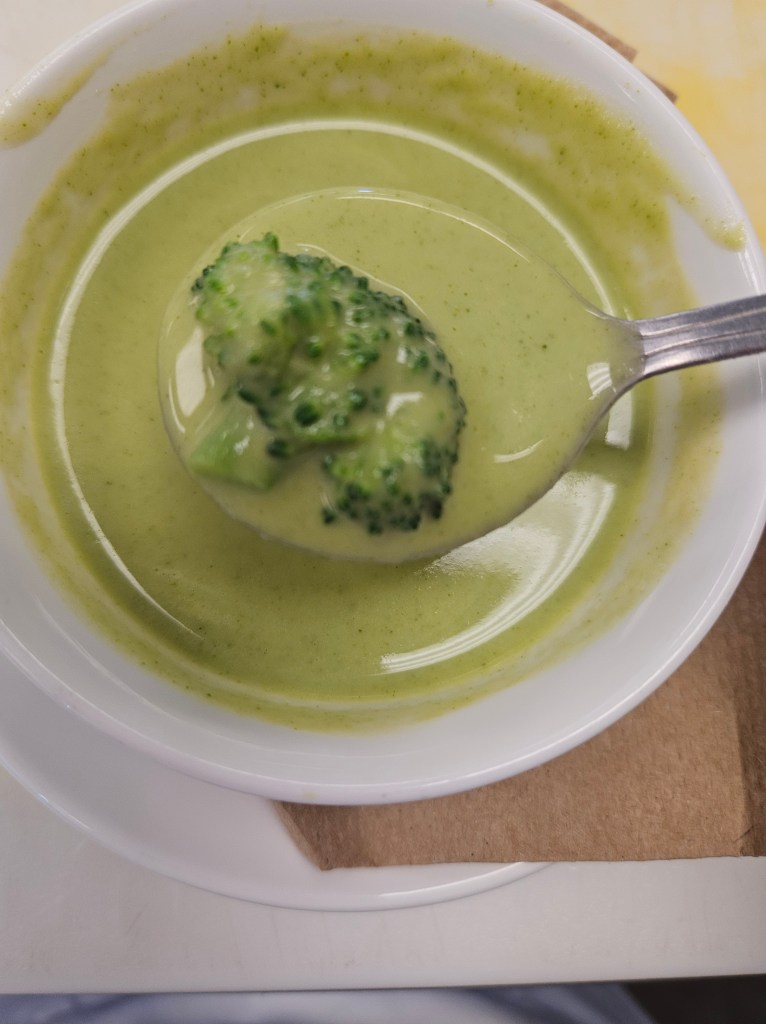
I had been dreading cream soups. On paper, nothing seemed more revolting. I had experimented with them in the past at home and felt truly baffled. It turns out, like most fine French cuisine, the answer is butter, cream, and attention. I had the chance to use a Vitamix to puree my broccoli and understood the hype of the pricey machines. My Cream of Broccoli came out smooth to the taste, with lovely little speckles. Garnished with a lightly blanched floret, and while I may not be ordering a cream soup for dinner any time soon, I was convinced of the appeal.
We also tackled a Pea Puree with Mint Cream. Yes, I whipped the cream by hand. Yes, my quenelle (the football shape of cold cream that should be smooth) is terrible. I brought myself to care about cream of broccoli, and even pea puree, but hand-whipped mint cream was out of my reach. My hands were shaking by the end of class when I prepped the cream.

Cream of Pea with Mint Cream and a bristly quenelle.

Traditional Minestrone felt much more like home. The recipe differed quite a bit from the one I made, but I was excited to see what would come of it. This version was delicate and light, but I craved the pile of garlic I usually added. The discreet little minces that our class recipe called for seemed to evaporate the moment it hit the liquid.
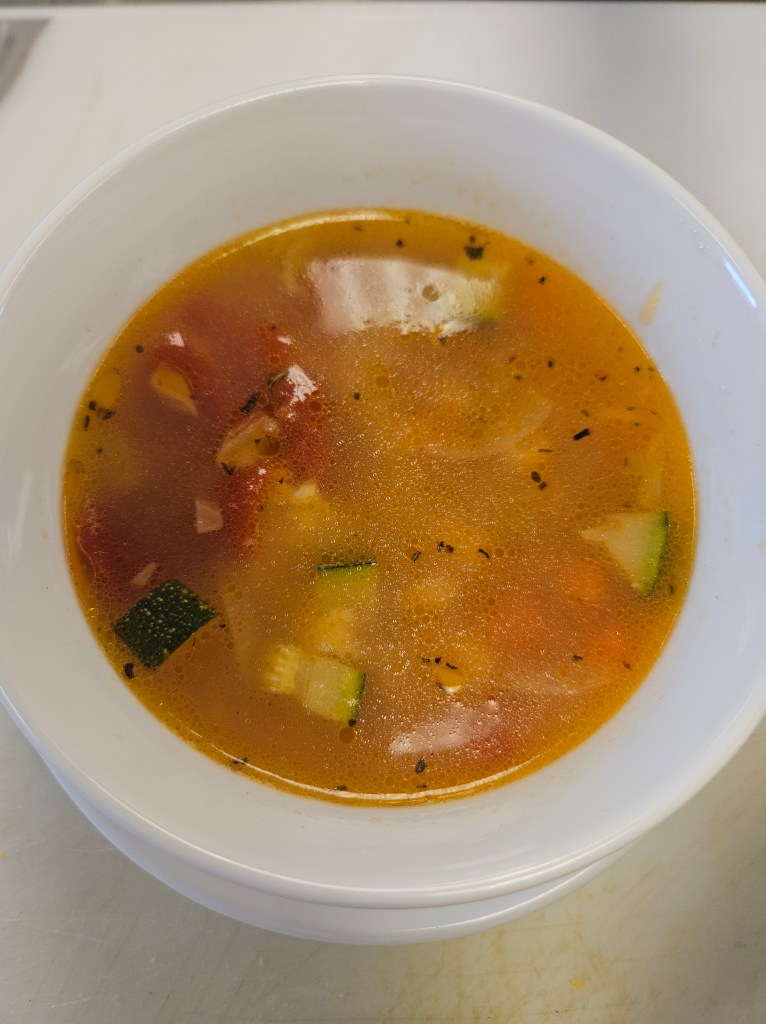
Fancy-pants Minestrone.

Which brings me to the real triumph: Green Chile Stew. This local hero of a dish is one of the greatest of the greatest. Pork, onions, tomatoes, potatoes, and heaps of hot green chile.
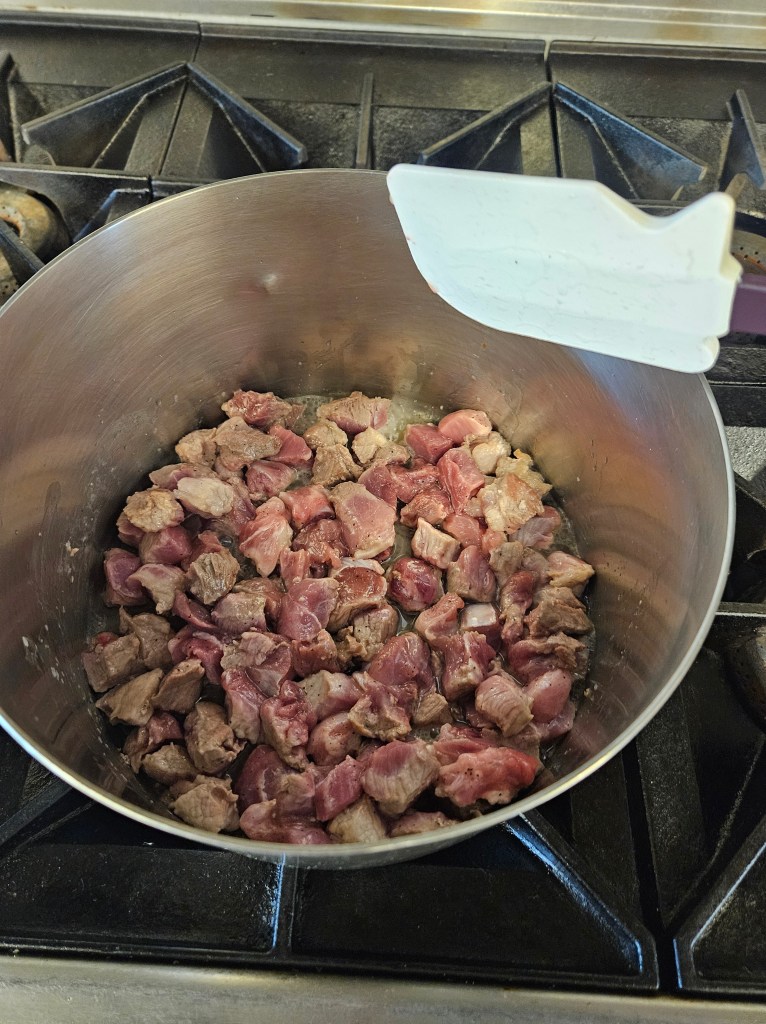
Sizzling pork, ready to be elevated.

We cooked the stew for several hours, over the course of two days. Using the blast chiller, we cooled our work from Day One, so it would be ready for Day Two.
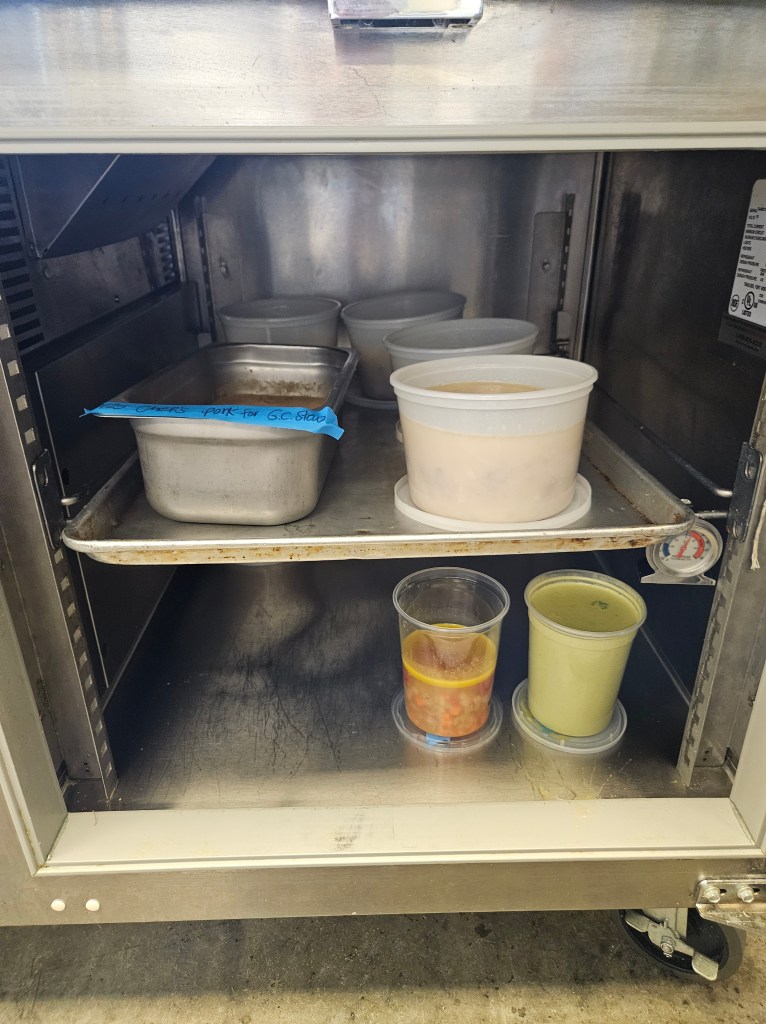
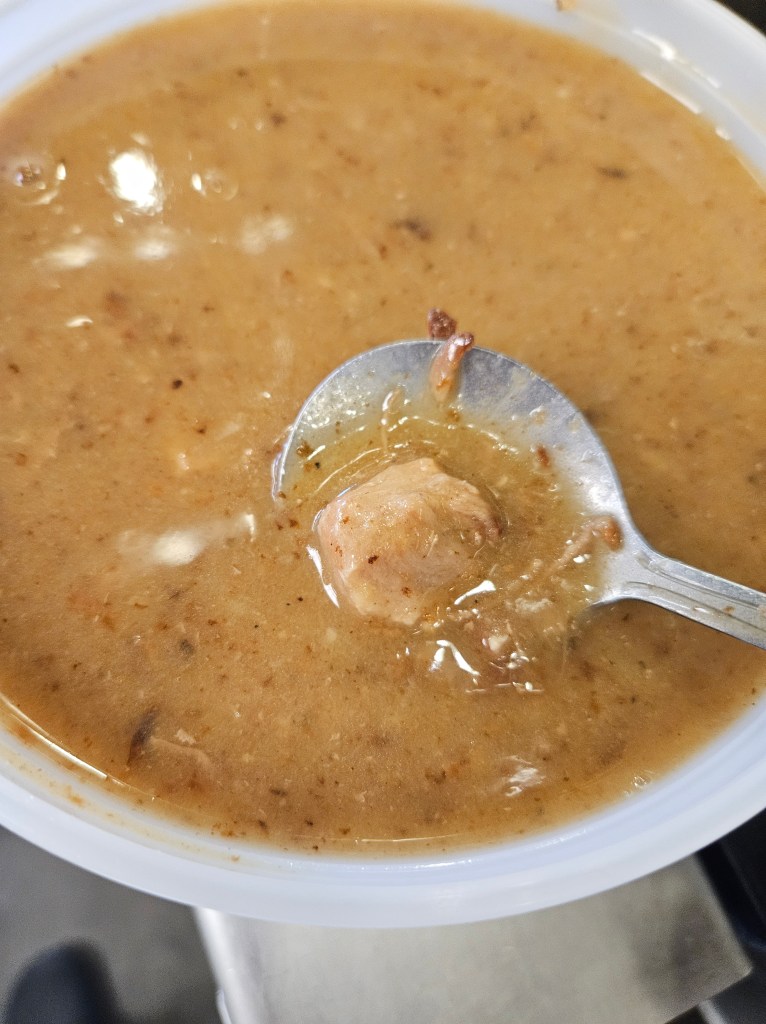
Soups cool exceptionally fast in the blast chiller, preventing bacteria from growing.
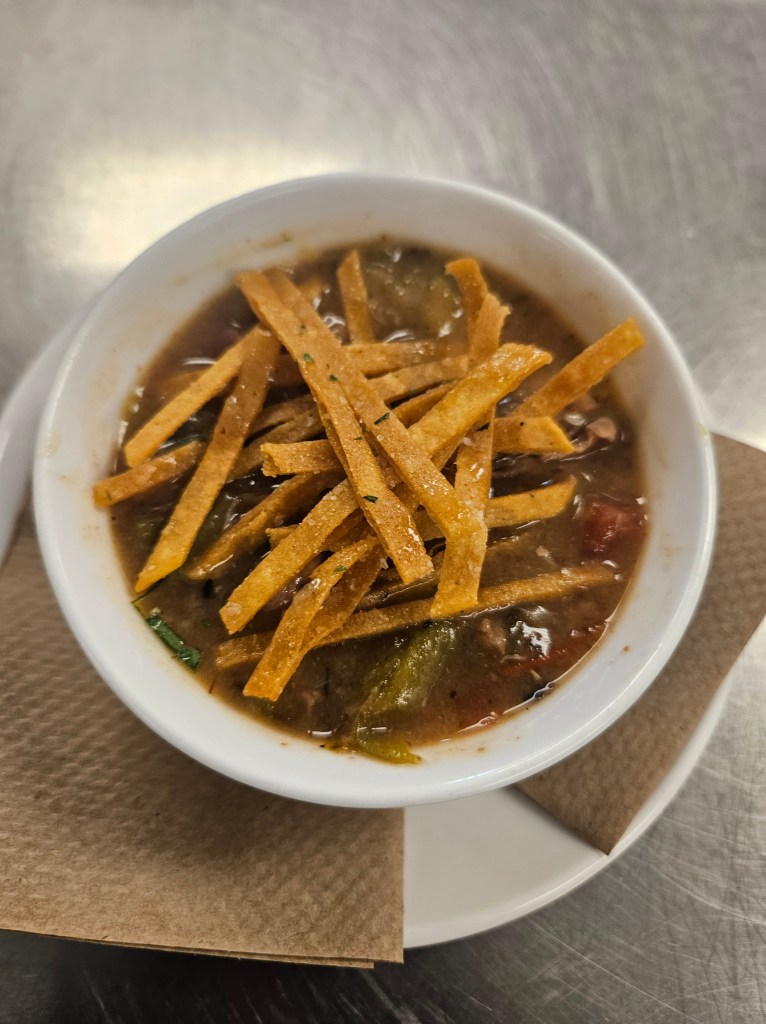
Delicious Green Chile Stew in process, close to ready for presentation. A triumphant dish needs an epic topping, though.
Corn tortilla strips becoming even more beautiful.
Cue the singing of angelic choirs.

Week Seven – Day Two: Mother Sauces II

“There is nothing new under the sun, but there are new suns.” – Octavia Butler

During one of the first days of class, Chef declared that it would be highly unlikely, and in fact probably impossible, that one of us (or any other culinary student) would create a brand-new dish. He explained that people have been eating for as long as there have been…well, people. And the ways that we approach cooking is actually highly standardized. I remember being taken aback, and thought his words were discouraging, especially coming from a teacher. Respectfully, how the hell would he know? But I’ve thought about his words, and what was more likely his true meaning (autists like me can often take phrases way too literally, as I was doing in this case). What he was really getting at was not short-changing our creative potential. Rather, the world of cooking follows a series of basic rules (altered slightly based on history and culture) and branches out in certain predictable pathways. I understood this concept more as we worked on sauces. It wasn’t that every single sauce that could ever be made has been made. It’s more about pulling back and seeing sauce-making (and food in general) as more about methods and approaches.

This perspective shift is one of the greatest changes for me as a home cook and future…somehow…professional…food something. Instead of seeing dishes as unique pairings, they are really more like formulaic composites. For example, “rice pilaf” is, according to my cooking textbook, a rice dish in which carrots, celery, and onion are simmered in butter. The rice is then toasted in the vegetable-butter mixture. Stock is added. The rice, carrots, celery, onions, butter, and stock are then cooked in an oven until the rice is tender. If we instead look at “pilaf” as a general method instead of a particular dish, then we have the following: vegetable + fat + grain + liquid + simmering heat (stove top) + radiant heat (oven) = pilaf. Rice can be swapped for bulgur, carrots for parsnips, butter for oil, and so on. Chef’s point was likely not that every single version of every possible pilaf in every universe has been named. Rather, the systems and practices in place mean that cooking is as much a science as an art. Perhaps more so.

As I mentioned in my previous post, even the most complex sauces are really just liquid + thickening agent + seasonings. And the results of those can just be repeated into “new” sauces indefinitely, with more liquid, more thickening agents, and more seasoning. The patterns are sort of beautiful, like when the veins of flower petals or plant leaves seem so random until you pull back and see the repetitions in their creation.

Okay, onto Hollandaise. The most brutal, unforgiving, and generally unsatisfying project in class so far. We did some other things that day which turned out quite well. I won’t be discussing those. I want to rant about Hollandaise.

I knew things were going to be tough when Chef said no professional makes Hollandaise like this any more, to which a starry-eyed fellow student asked: “Chef, is there then an increase in quality if we prepare it by hand?” Chef answered, “No. It’s almost always worse. Most professional cooks use blenders, which are much more dependable and accurate.” Student: “Then why do we do it this way?” Chef: “To punish Culinary Arts students.”

-_-

Hollandaise. Here is how Chef made his:

  1. Make an au sec (“almost dry”) reduction of vinegar, crushed peppercorns, and salt. Strain.
  2. Make a hot-water bath by simmering water in a pot. Cover with a towel and place a bowl on top
  3. Beat egg yolks and reduction until ribbons appear.
  4. Slowly add warmed clarified butter and continue beating.
  5. Thin with lemon juice, if needed.
  6. Add salt as needed and a pinch of cayenne.
  7. Get the mixture up to 135 degrees. Serve and enjoy.
Chef preparing his Hollandaise and making it look easy.

Here is how I made my Hollandaise:

  1. Ask Chef if we have to actually hand-crush the peppercorns. (Chef says yes). Make an au sec (“almost dry”) reduction of vinegar, crushed peppercorns, and salt. Strain.
  2. Make a hot-water bath by staring at your water for what feels like 45 minutes. Nothing will happen. Walk away for three seconds. Come back to a roaring boil. Reduce heat and wait another 8 days for the water to come down to a simmer.
  3. Cover with a towel. The towel will immediately fall into the pot of water right when Chef is looking. Place a bowl on top.
  4. Beat egg yolks and reduction until ribbons appear. Forget what “ribbons” means and/or looks like.
  5. Beat forever.
  6. Sweat in actual rivulets. Keep beating.
  7. Okay, maybe that’s a ribbon.
  8. Slowly add warmed clarified butter and continue beating.
  9. Realize that your towel is on fire. Smack it with your whisk to get it out because you can never stop beating.
  10. Thin with lemon juice, if needed. Accidentally pour it all in because your hands are shaking because your arm muscles are goo.
  11. At this point, it will thicken and actually look sort of correct and beautiful. This is a fleeting moment that you should treasure.
  12. Add salt as needed and a pinch of cayenne, which you forgot to do earlier.
  13. Beat forever. The pain will never stop.
  14. Listen to the screams of agony around you as your classmates ruin their Hollandaise one by one.
  15. Get the mixture to 115 degrees and feel confident. Try to poison Chef with it, who then reminds you it needs to get to 135 before being served.
  16. Die inside.
  17. Your uniform is wet. You are wet. The pain is everywhere. Never stop beating.
  18. The mixture reaches 130 degrees and breaks.
  19. Scream.
  20. Start all over again.
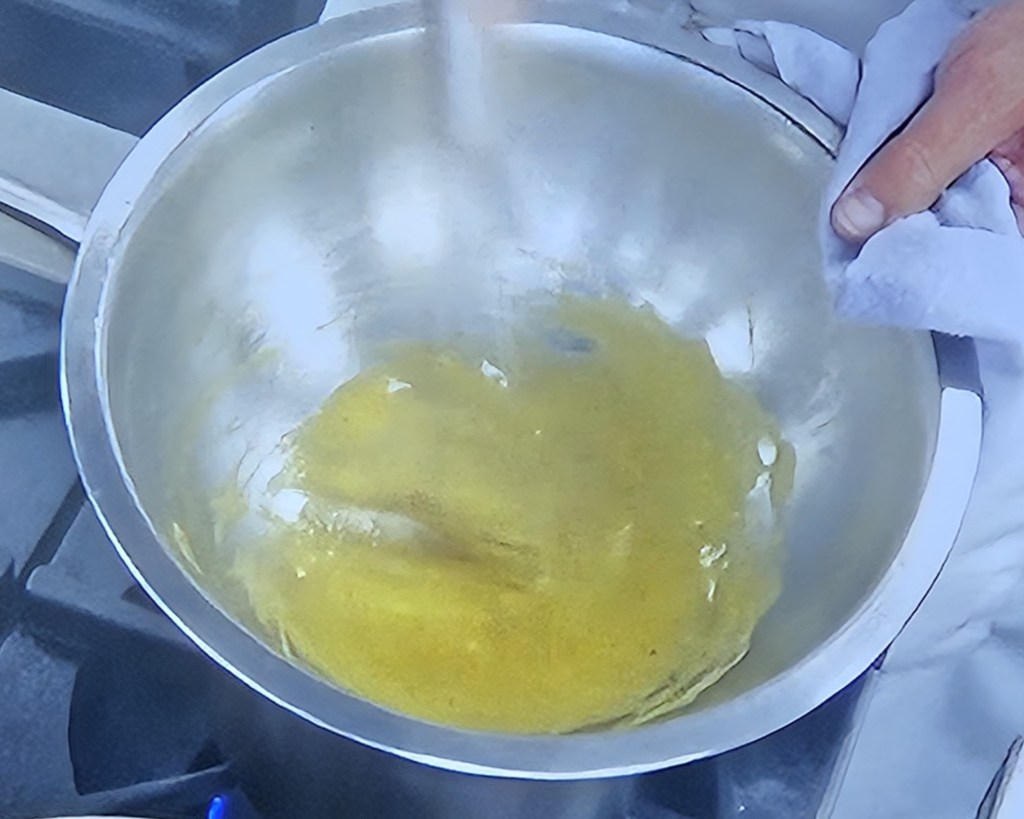
Absolutely profoundly incorrect Hollandaise.
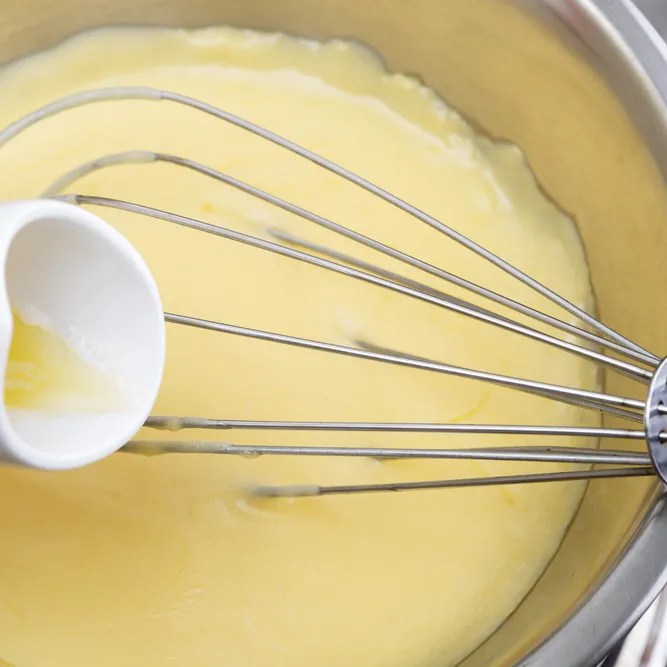
What Hollandaise should look like. (Source: Epicurious, link)
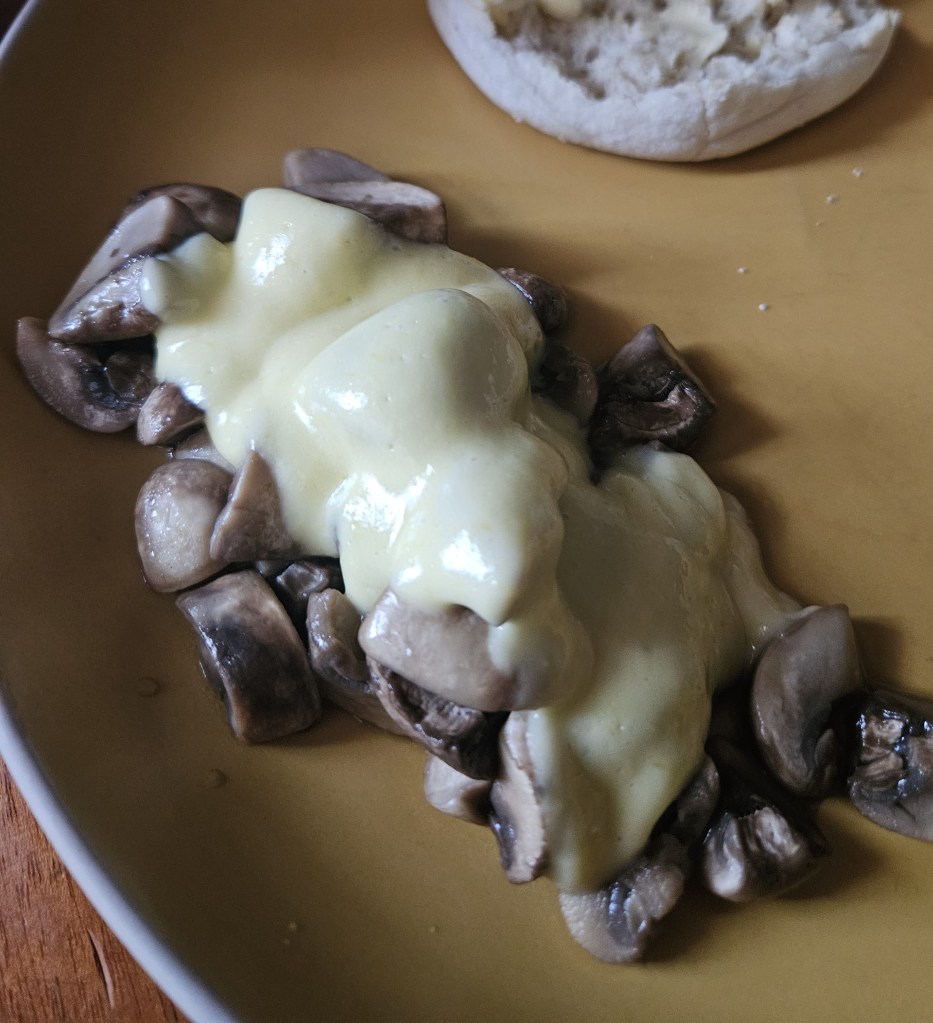
Hollandaise take three, prepared at home, with sauteed mushrooms.
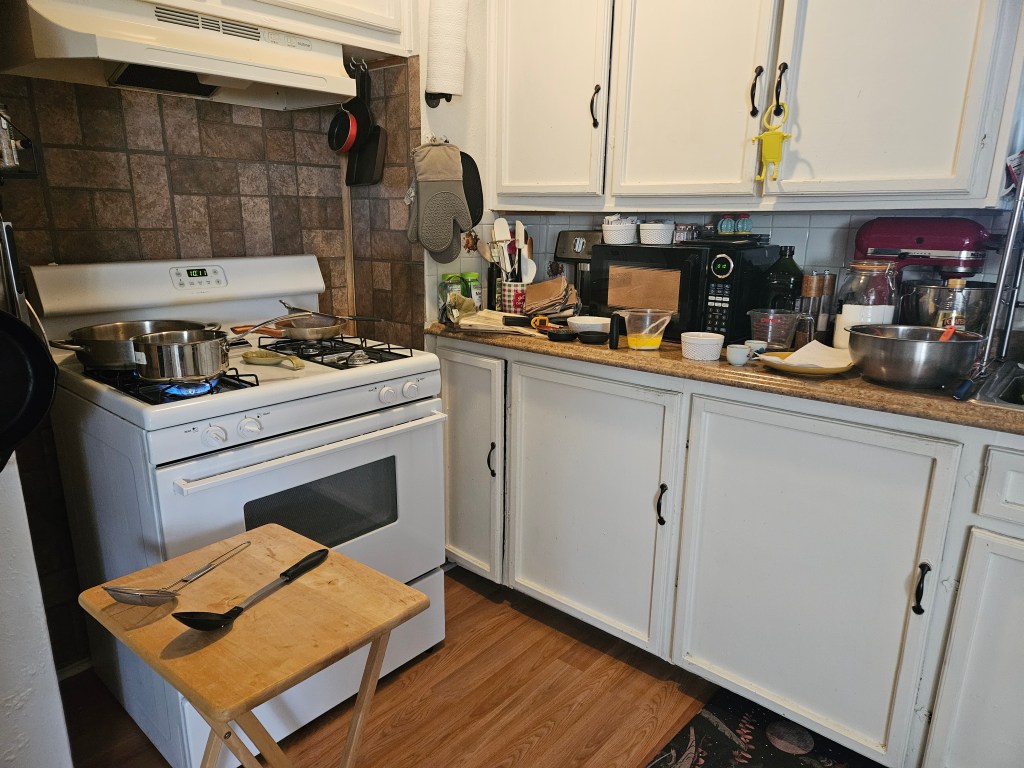
My home kitchen, exploded. All this for two servings of Hollandaise and two poached eggs.

The best part is when you taste the Hollandaise that you bled, sweat, and cried over and you realize…you don’t even like it.

Week Five – Day One: More Chicken. Yes, Even More Chicken

“Some goals just ain’t meant to be microwaved, baby.” – LaNia (tiktok)

This week was the one that changed the kitchen lab for me. I’m still not sure if for better or worse…

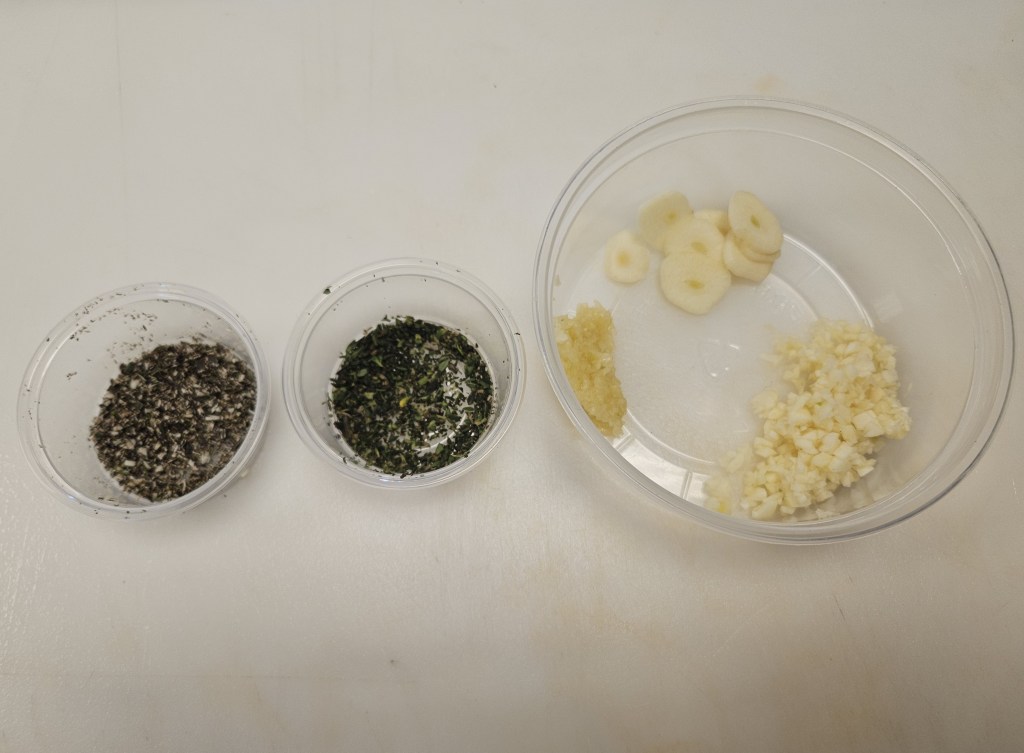
Next week is the midterm exam, so this week’s work was all about more practice and preparation. We would fabricate another chicken, saute a breast, pan fry a leg and thigh, and practice more knife skills. Those included sliced, chopped, and mincing garlic into a paste, chopping various herbs, and slicing and grilling zucchini. We also learned multiple methods for slicing vegetables like bell peppers and onions for different preparations. 

I’ve started loving the thrill of multiple tasks, and getting to approach them in my own ways. I feel more in control of my work, making the wins that much more meaningful. 

Chopped herb practice, and garlic three ways. I’ll never go back to buying garlic paste again.

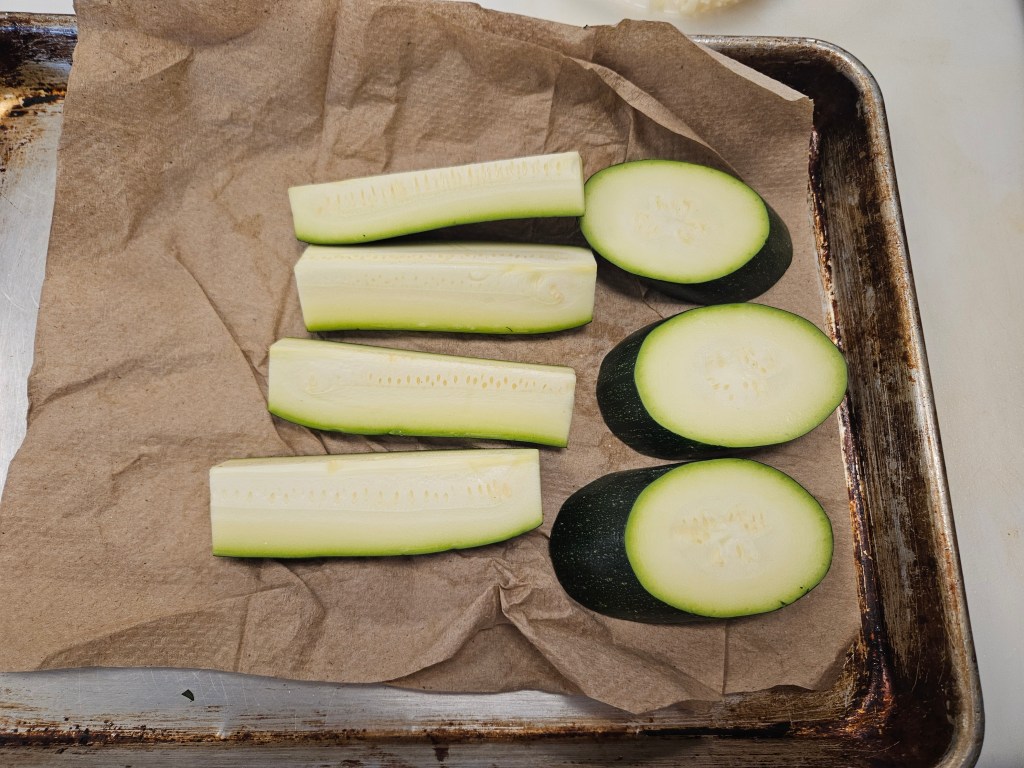
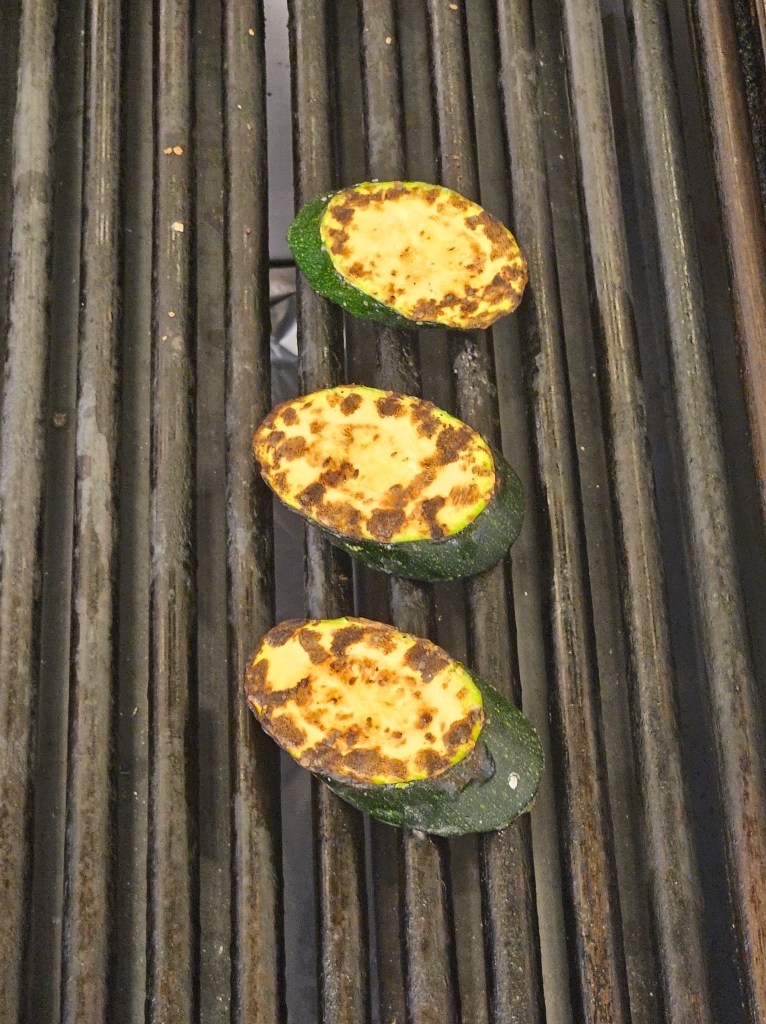
Slicing vegetables and preparing garlic and herbs is very much something I love doing at home, so I knocked those out quickly. Preparing and grilling the zucchini was sort of a thankless task. At the end of slicing and cooking, you still just have…a brownish zucchini.  Chef did say my seasoning was on point, though, and that I was successful in making zucchini look edible (for the win?) with “great color.” I’ll take it!

The secret to water-heavy vegetables like zucchini standing up to the grill are thick, even cuts. Shrinkage is real, people.
You can’t really get the cross-hatch marks on zucchini (correction: I cannot), but you can still get a nice color with proper seasoning and patience.

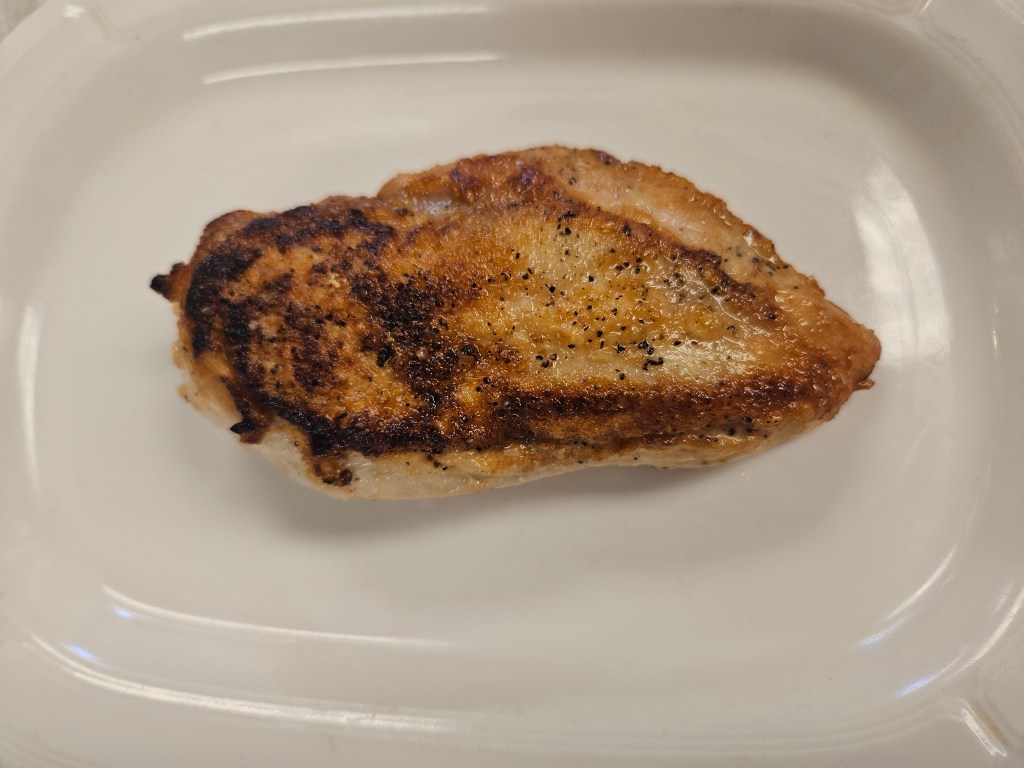
I am getting disturbingly fast at breaking down a chicken, as well as pan frying. Sauteeing still keeps throwing me off. Today, time was once again not on my side. Chef began counting down minutes while I was convinced my breast was still underdone. We had to saute with skin on today, making timing even more difficult. How to keep things crispy on the outside, juicy on the inside, and still fully cooked…

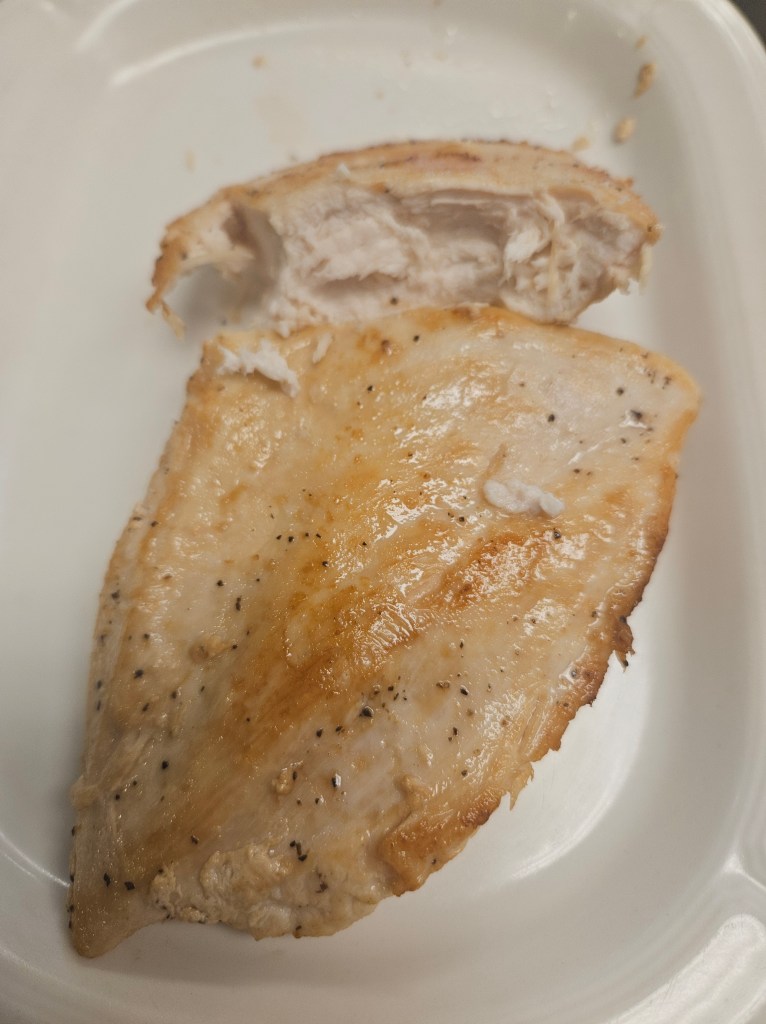
I pulled the breast for a blink-and-you’ll-miss-it rest, as minutes turned to seconds. I had to plate quickly and was sure I was presenting an underdone piece of meat. It turns out that time constraints actually forced me to cook the breast properly. She was perfect, and Chef even laughed at me a little, since I was forced to get out of my head and JUST COOK.

The sexiest of sautes.

Things were starting to feel good. Really good. I was getting a handle on my real skill sets in the kitchen, and seeing where I needed practice. Having a growth mindset is tough, but it’s about getting back up. Today’s class was one of the first times I felt the home cook meet the kitchen lab cook, and visions of a possible future chef seemed less like a strange dream and more like a future. I still wasn’t sure where I wanted to end up. The kitchen life is hard, and I am a creature of comfort. I don’t like sweating, or yelling, or burning myself, or standing up for hours. And yet, something happens to me when I’m in class. Some sort of core activates inside and I just move. I am in no way great. And in no way even good. But there is something electric inside me when I chop, and cook, and plate, and move on to the next task. I still don’t know quite what it is or what it means, but it’s becoming harder to ignore. 

Ironically, the next class brought total catastrophe and pushed these feelings even deeper into my mind. On a day where everything goes wrong, and everything around me is miserable, on a day where I epically and publicly fail spectacularly, do I still love to cook? Could my worst day in the kitchen also be my best day?

Week Four – Day Two: Is Culinary School Like a Cooking Reality Show?

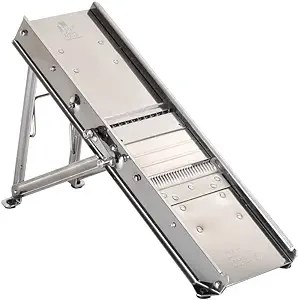
Today, the kitchen lab felt less like a stranger and more like a friend. A new friend. One I’m still feeling out a bit. Much of the work during the last class was preparatory for today’s assignments: gaufrettes, bruschetta, julienned carrots. The food was simple, but the equipment was what was special. Being a passionate home cook is a great hobby, but it can get expensive.  Plus, my kitchen space is tiny. I try to avoid buying gimmicky items, and things that are only for one purpose. The lure of specialties is palpable, though. Being in culinary school means I can handle items I would never experience as a home cook. Today’s class offered me the chance to use the terrifying deli slicer, salamander, and French mandolin. Memories of medieval torture devices from my graduate studies (and Hannibal) danced across my mind.

French Mandolin (Photo: Amazon, Direct Link)

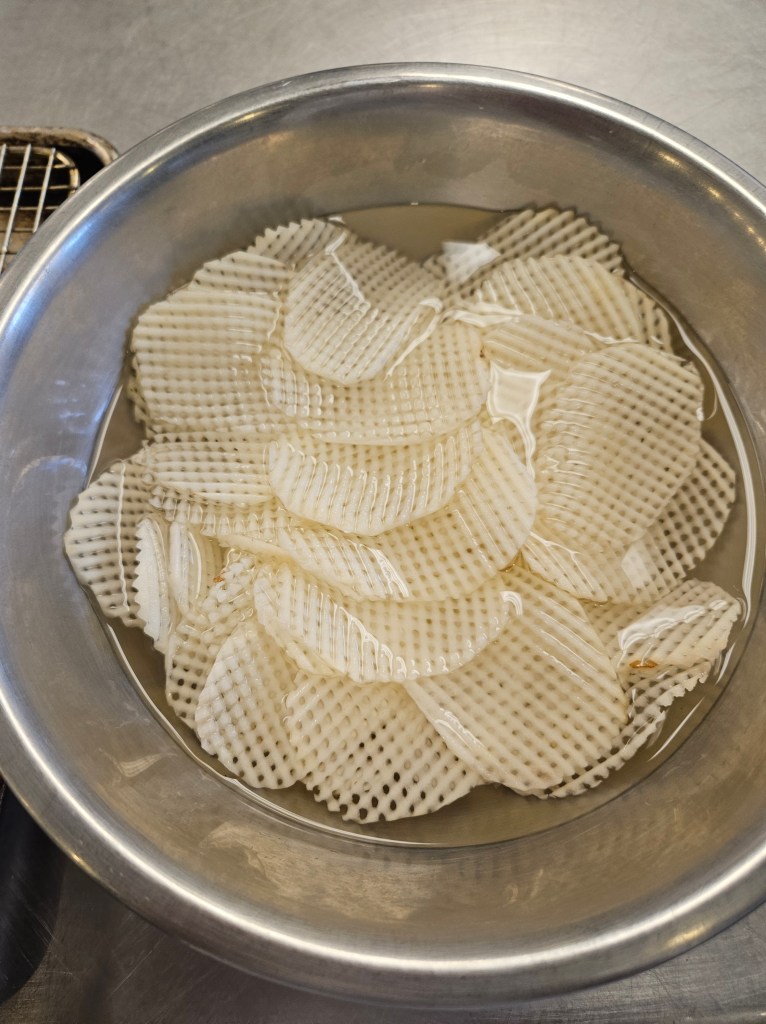
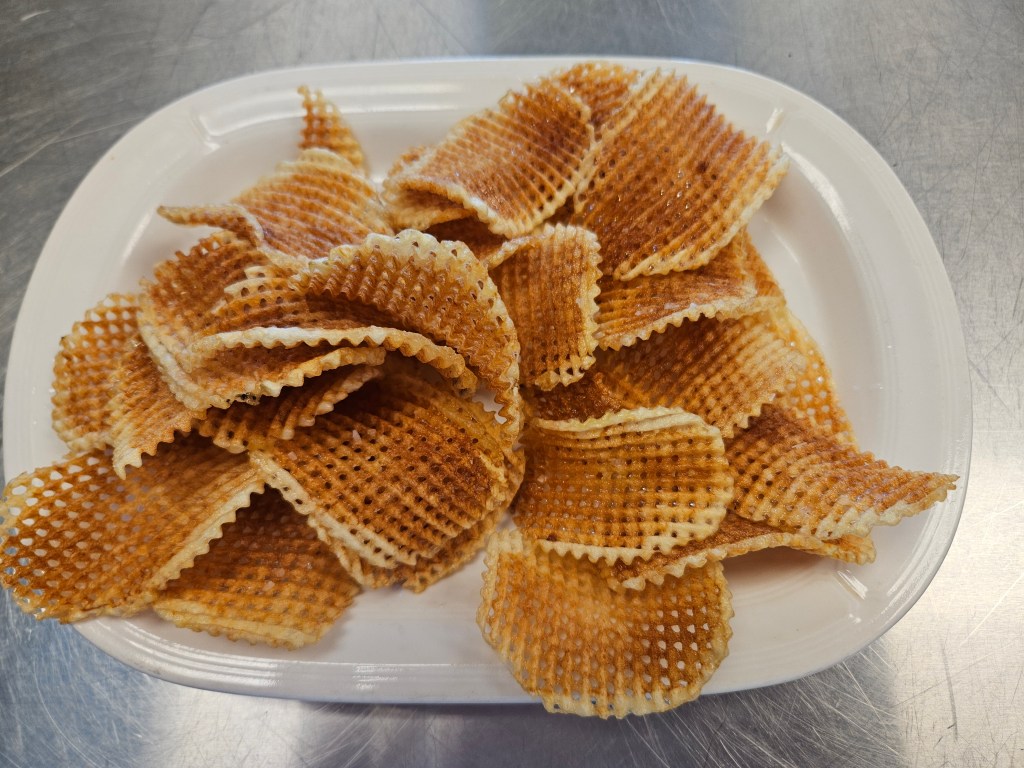
French mandolins can be used for multiple things, but uniquely offer a tight cross-hatched pattern for a potato dish called “gaufrettes.” They look like ultra-fancy waffle fries and taste like the most expensive potato chips ever. We also used the deli slicer, which is a giant electric machine that seems like it will take off your whole arm. But, there are multiple safeguards in place so it’s actually quite difficult to hurt yourself without trying. The French Mandolin is where the real fear lies, but it was an absolute treat to handle it, knowing I likely never would again. There are so many gifts in culinary school, despite the danger (and pressure).

Sorcery!
Finished Gaufrettes

When I was earning my MA in Dance, friends and family would squeal, “Oh, is class like ‘Dancing With The Stars?!” After gagging on my water, I had to politely say that no, real dance study is a totally different planet. Now, I get asked, “Is culinary school like those reality cooking shows?” The answer is more nuanced. I usually say, “Not really, but….kind of?”

First, the goals are different. I’m not in competition with my fellow students. I’m in competition with myself. Sharing tools, ingredients, notes, and advice are how to survive the huge amount of information we are all processing. Also, I very much am here to make friends. I seek knowledge and community in this space. So, the dynamics among us are much more different than the delightful pettiness we see on tv. 

But, the structure and nature of the class is reminiscent of a timed, judged competition. One night, my partner and I were watching one of those high-stakes cooking competition shows with a lot of screaming and crying over cheeseburgers or something. They asked me, “Is that what it’s like?” It really is. Competition with myself is in many ways more difficult than with others. And presenting to Chef is always nerve-wracking. The kitchen is also LOUD, and needs to be. We have to shout “Corner!” “Behind!” “Open Oven!” “Hot plate!” not just because it makes us look really fucking cool (which it does), but for safety reasons. Each of us is deeply immersed in our tasks. Sneaking up behind someone who is finely dicing a carrot is a bad idea. 

We have a set end time in class. Chef announces markers like “Halfway!” or “Fifteen minutes left!” and his personal favorite, “If you aren’t in line, it didn’t happen!” If we make it to the tasting line when our cooking time is up, he will grade our work. If not, your food doesn’t count for a grade and you get a zero. 

The process of Chef’s review itself is serious, too.  It’s a profoundly intense few moments. In class, Chef grades us live, so he sits at a table with his laptop next to him. Eyeglasses balanced on his nose, he doesn’t usually make eye contact with us, but looks at his laptop. You hold your plate in your hands until he slaps his palm twice on the wooden table, signaling he is ready to review. You announce your food, “Poached eggs, Chef,” and wait. He inspects it visually, turning the plate around. Sometimes he touches or pokes at your food. He doesn’t always taste, but when he does, he reaches for a spoon in the trays next to him (still not looking at you, always looking at the food). 

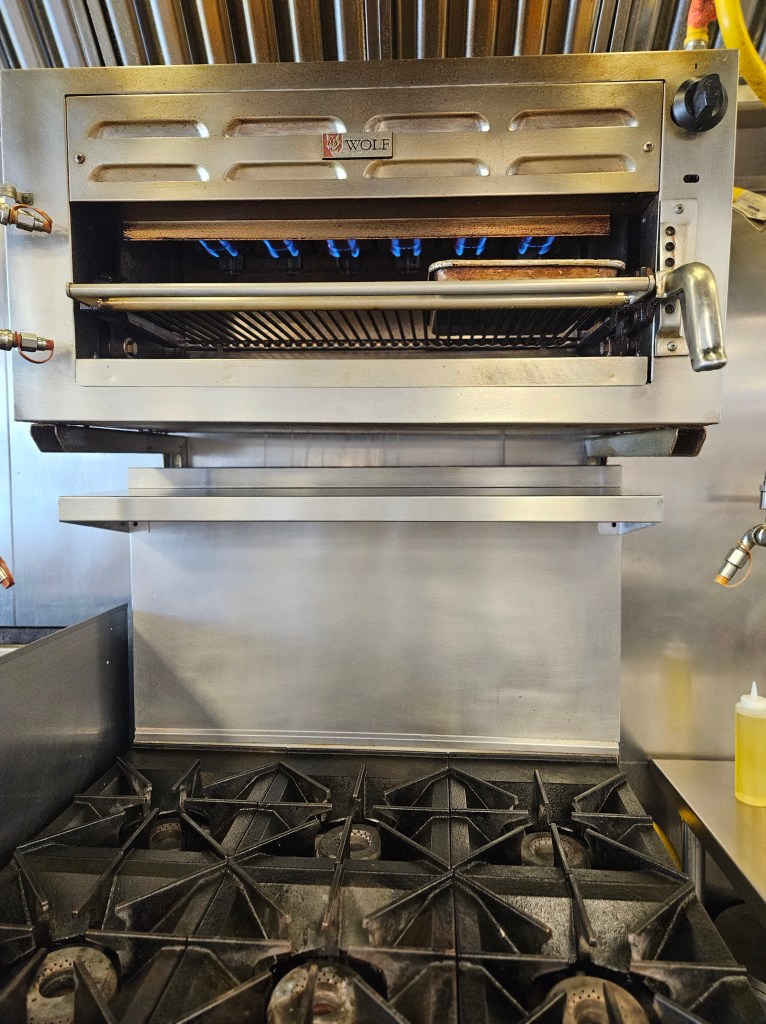
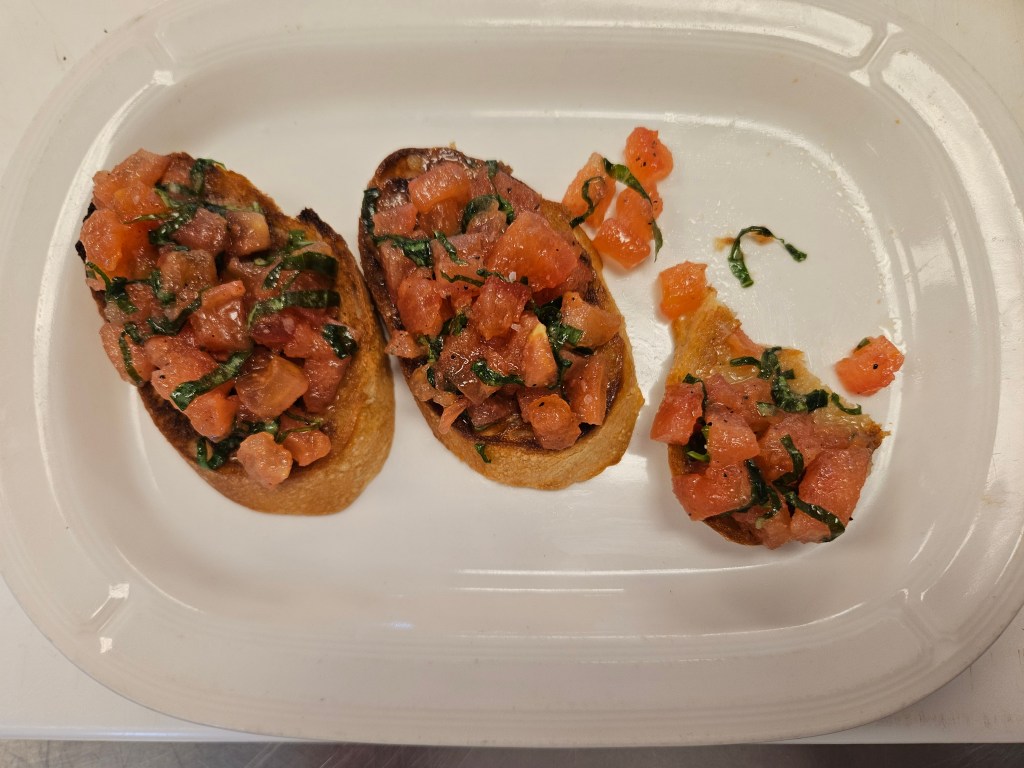
Today, I was meticulous about my bruschetta. We toasted our baguette slices in the salamander (a giant broiler that is basically a Hulk version of the one in my oven at home). The heat is intense and toasting takes seconds. My roasted garlic from last class melted perfectly as I scraped the cloves across the rough bread. My tomatoes mixed with herbs and olive oil sat delicately, looking somehow light and decadent with their ribbons of basil chiffonade. I worked my ass off on those little bites. And it paid off. Chef looked them over and declared them well done. He also took a huge bite and I EVEN GOT “MMM MMM” NOISES!  “Delicious,” he said. Fuck yes.

Bread toasting in the salamander
Look at that big bite!

As if the day couldn’t get any better, I finished early (HOW?) and Chef allowed me to redo my eggs over medium for a grade.  I prepped them as quickly as I could and took a deep breath, begging my tablemate not to watch. I FLIPPED THOSE BABIES!  I yelled, “I DID IT!” and even got applause from a nearby student. In my excitement, they were still underdone, but I didn’t even care. More than getting to erase the zero on my record, I managed to do one of the hardest tasks I’ve ever done in the kitchen. Which was good because these eggs are on the midterm…

PERFECTLY FLIPPED!

Week Four – Day One: Butter Queen

To whom do I owe the biggest apology? No one’s been crueler than I’ve been to me. – Alanis Morrisette

Today was the first day I missed my old work life. Bad news came from the field over the weekend. I found it hard to concentrate in class, still mulling over the events detailed in the news. I was in deep dialogue with my community members. In my old roles, my organizations may have issued a statement, or at least had several conversations about the issues. I loved cooking, and usually loved being in class. It was unsettling to feel disconnected. Just a few months ago, I would have been immersed in this news, deconstructing meaning and doing supplemental research to dig deeper. My mind wandered in the morning lecture. I knew that I was in danger of losing my mise en place mindset, focusing too much outside the kitchen. But, it was the first time that I wanted out of the classroom and back on my computer. 

Routines and transitions are difficult for me. Much of the struggle is my autism, but a lot of it is age and habit, too. I like things the way I like them. I’ve carved my morning order of operations into my dining room table. My partner knows my coffee preference and the dogs know when to start angling for breakfast. Adjusting to no job and being in school has been difficult. The first week was exhausting in a way that made me wonder if I should quit. Things got better as I started making accommodations for myself, and getting into the rhythm of school. I was annoyed with myself to feel called away so soon, after so much work to get to a more comfortable place. 

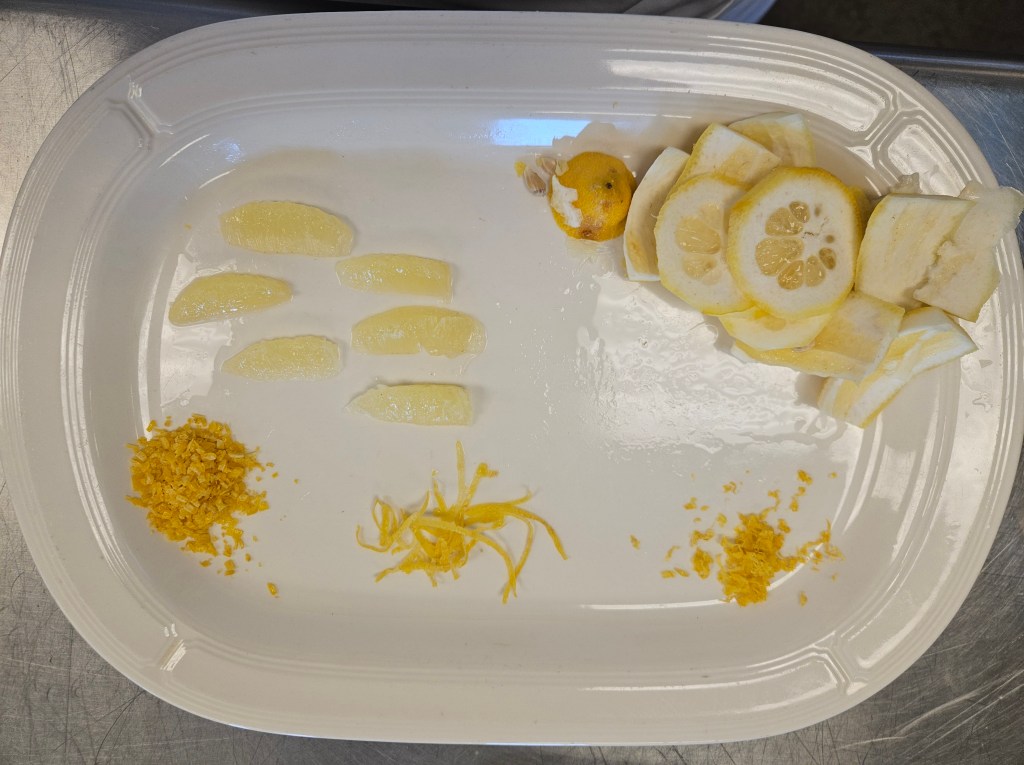
Luckily, kitchen assignments that day were a hodge-podge of techniques and skillsets. I felt relieved that the workload was a little lighter, and in areas I was more comfortable. We were to practice more delicate knife work via supremes (a fancy way to say citrus segments), zesting, and chiffonade, plus upgrading butter via methods of clarification and compounding.

On paper, the supremes seemed overly fussy and pointless to me. I was surprised how much I enjoyed gently carving the lemon peel away from the flesh of the fruit, and delicately sectioning out each perfect slice with no pith or membrane. Knife cuts of vegetables had been humbling. Maybe I was a fruit carver at heart?

Zesting with a knife (and chiffonade, which came later) were really more about how to handle a delicate food object without absolutely destroying it. We were meant to create consistently thin strips of basil, plus tiny usable zest using our paring knife. These were tedious tasks but the results were lovely. And sensually gratifying. My fingers quickly smelled of fresh lemon oil. I remembered taking literature classes in my undergraduate career where we studied the Song of Solomon, and how the lovers drenched their hands with sweet smelling oil so every touch would be loaded with scent. 

Chef asked us to save the trim from our lemon to assess how much flesh and zest we were able to get off the fruit.  A few segments were sacrificed for lemon juice in the compound butter. Zesting down by hand (left), using a grating tool (center), and using a microplane (right).

Compound butter was simple and fun – an ingredient I will start using in my home kitchen. Softened butter mixed with finely chopped parsley, lemon juice and zest, salt, and pepper, turned into a log and chilled. In the next class, we cut slices of the delicious butter to elevate carrots.

Roasted garlic was another delight. I was happy to get started on that early and get her to a really beautiful deep golden color. A few of my classmates had never made it before and were convinced it was more complicated than just balling the olive-oil-drenched garlic up and tossing it in the oven. It was comforting to know what I was doing for once, and to also have the capacity to pull it off. Even if it was the easiest thing we will make all semester.

The ancestors would be proud.

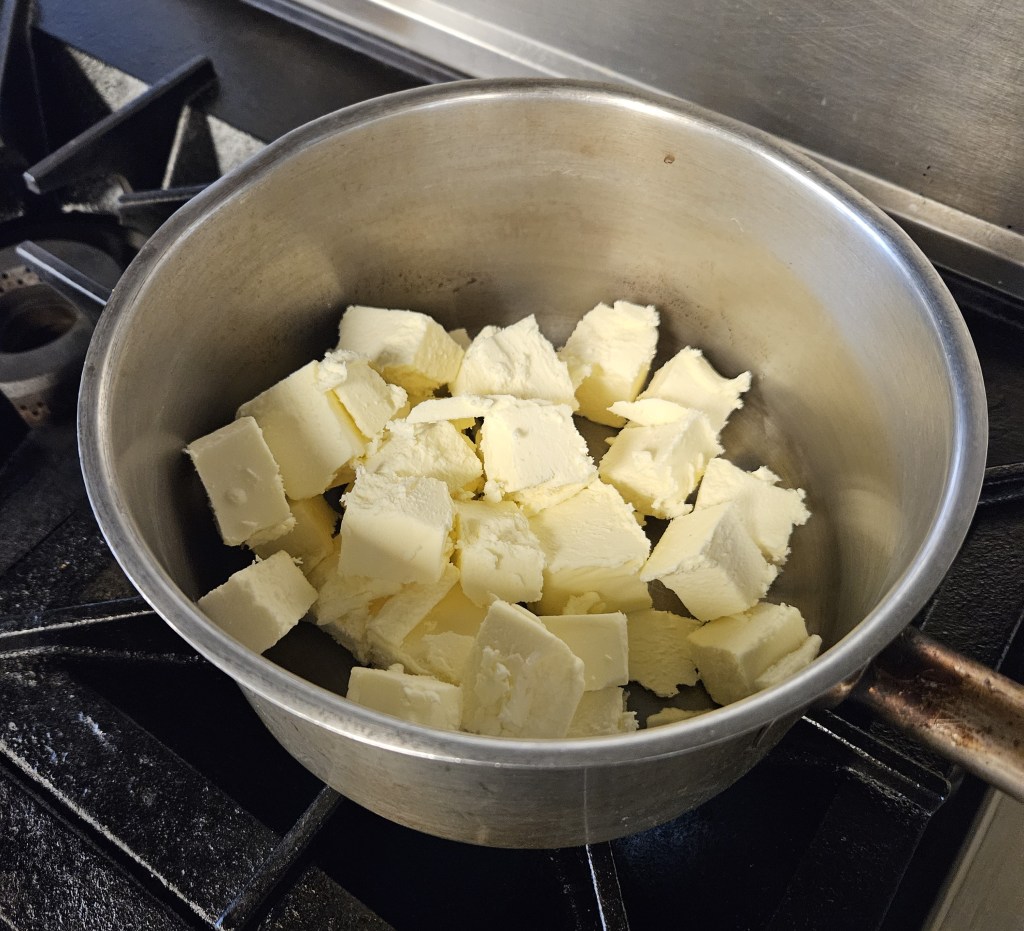
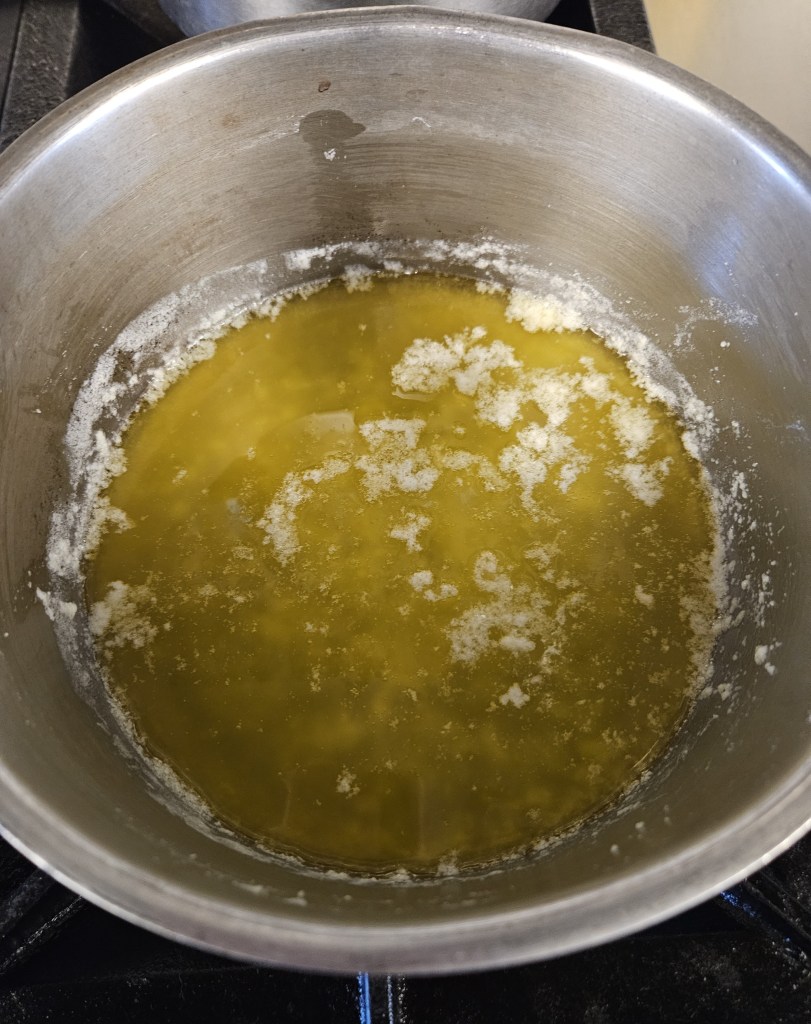
My moment of triumph was clarified butter.  I followed Chef’s instructions closely and knew in my mind what I was going for, but had never made it before. This practice was another example of me learning to trust myself and not paying attention to everyone else. Clarified butter is butter cooked until the milk solids solidify and can be removed. The result is a refined butter with a higher smoking point, which is for more versatile cooking. Clarified butter allowed to continue cooking until a deeper, nuttier flavor develops is ghee. I saw other students’ saucepans bubbling differently than mine. They were scooping faster and faster. My pot looked…lackluster and wrong. At one point, I asked Chef to look at it. He said it was on the right track, and even pointed to other students’ pots and said, “Yours needs to look like hers.” I was stumped. It was a “trust the process” moment. I moved to other work while I repeatedly checked on my pot, never letting it come to a full boil. 

Cubed butter ready for the clarifying process.
Me: This cannot be right. Chef: Looks great! Me: … wtf …

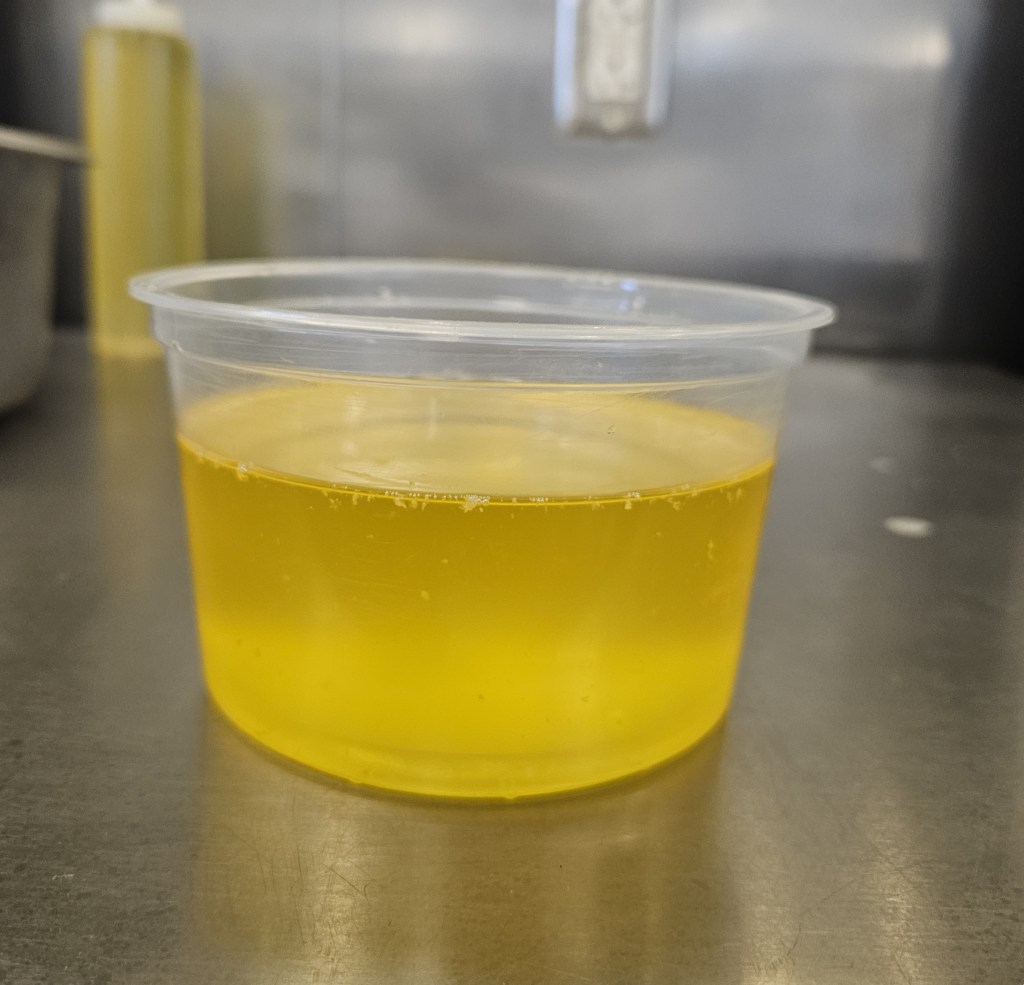
Chef shouted “Five minutes!” and I began to sweat. I had to get those milk solids out and the clarified butter into a container. I had waited until the last possible moment, but I was committed to making an excellent product. If Chef said I was on the right track, why would I pull over? My 4 ounce ladle felt huge in my hand as I scooped tiny tablespoonfuls of clear butter into a deli pint. I could feel myself starting to panic and I just focused on the butter. Time moves differently in your mind. If you ever stop to actually count out 60 seconds, one minute feels like an hour. I kept telling myself, “You have time, you have time. Keep scooping.” When I finally got every last drop I could, the result was an almost clear, stunning amount of butter. Chef declared it “Excellent,” as the last minutes of class cooking time slipped away. It was just butter, but it felt like an astronomical win.

She’s beautiful.

Of course, hubris is a danger to us all. As I floated back to my station, Chef yelled, “Mary, where’s your chiffonade?!” Oh fuck. Then he yelled, “One minute!! If you aren’t in line, it didn’t happen!” Fuck, fuck, fuck. I plucked my basil leaves, rolled them snugly and focused on not getting sweat on the plant. Gone were my beautiful thoughts of scent-drenched fingers. Now, I was just trying to get something on a plate. I slammed my knife down at “Fifteen seconds!” and joined a few others who frantically made it to the line. Chef dismissed my chiffonade as “Fine” which I would absolutely take. I was more than happy to dive into dishes and trash clean up after getting so much good work done.

Week Three – Day Two: Catching a (Proverbial) Rat

Shocking as it may be, I was excited to turn back to eggs in this class, since no flip was required for today’s assignments. The eggs assigned were delicate, but not the diva-level theatrics that flipping required.  This class would prove to be difficult, but I felt prepared. I had practiced over the weekend and knew the theory inside and out. I felt confident, but also wary. After all, I had felt confident in the kitchen before…

Today’s class was about a variety of moist heat methods, meaning submersion in liquid, usually water or broth. The previous class categorized frying, sauteing, and grilling as “dry heat.”  We were also tackling omelets. The lineup included two poached eggs, two simmered eggs (colloquially, “hard boiled,” but Chef encouraged us to release that name since we didn’t technically boil the eggs), one poached chicken breast, an American omelet, a French omelet, and steamed carrots.

A general rule in the kitchen is to start your time with items that take the longest. This approach allows some room to course-correct if things go awry. I planned my omelets for last, as I was most confident in those, and started in on simmered eggs. Simmered eggs are simple as long as you set a timer and don’t delineate. Start with room temperature water, add eggs (we used two, and adding more will change the cooking time slightly), and bring to a boil. Once a boil begins, turn off the heat and set a timer for 18 minutes. Chef assured us they would be perfectly and fully cooked. At over a mile high elevation, which can mess with anything in boiling or simmering liquid, I’ve learned to trust my own community rather than cooks from other places in the country. Plus, obviously, he’s Chef!

From left: Chef’s French omelet, American omelet, steamed carrots, poached eggs, simmered eggs, and poached chicken.

Knowing we had to take turns using the combi-oven (a giant convection oven), I wanted to be one of the first. I prepared my batonnet carrots as fast as I could, though not fast enough to make it to the first steaming round. I focused so much on sizing that I forgot about length. Chef nailed me on that: “These should all be the same length!” He sounded annoyed. Damn. I just kept coming up short on these cuts. 

One other difficult element of the kitchen classroom is that hot foods need to be plated on hot plates and cold food on cold plates. My tablemate had placed plates in the oven to warm, but when I opened it up to plate my carrots, my heart sunk. He had actually placed platters in the oven – larger ceramic pieces that would take forever to heat up. I ran to get more plates and rearranged as best I could. My carrots were rapidly cooling. I had added melted butter, salt, and parsley when they were fresh from the combi-oven, but things were rapidly congealing. I tried putting them in the oven to warm, but it simply wasn’t hot enough yet. I tried the shelf above the stovetop, but the same issue plagued me. I gave up, went for the oven, and tried to move on. 

I turned to poached eggs, embracing the idea of struggle and ready to remake if I needed to. They are incredibly temperamental, as anyone who has attempted them knows. I dipped my eggs slowly into lightly simmering water, about a tablespoon of vinegar, and a swirling vortex of water. I gently stirred around them to keep the egg white tails from sticking to the bottom of the pan. Miraculously, they held their shape. I stared at them, refusing to move, in the hopes of actually succeeding on the first try. I dipped a spoon into the water to lift and inspect one. You can tell how set (or un-set) they are with a gentle wiggle. Still under. Back into the vortex and more laser-eyed staring from me. After a few more seconds, I removed them and placed them on a pan lined with paper towels. You’d think I was operating on a heart, the way I was sweating so much. I was terrified of them breaking on the paper towels. By some miracle, they held, and I gently rolled them onto the plate. A sweep of a paper towel to remove excess water and I ran to present them to Chef. He swept a spoon through the yolks and we watched them spill out beautifully golden all over the plate. He tasted and proclaimed my seasoning excellent and my cook flawless. I almost died and went to heaven. Sure, I had a whole day of work ahead of me but perfect poached eggs is a win for anyone.  

I checked my steamed carrots and they (and their plates) were still barely lukewarm. I had to make a choice. I couldn’t wait for them to dry out, so I just plated and presented them. Chef was less than impressed. “Cold,” he said, and shoved them back toward me. Looking back, I shouldn’t have rushed and just waited for them to warm up. I’m still dealing with the rigorous balance of time management, temperature management, and presentation management.

My simmered eggs were still happily cooking, so I moved onto poached chicken. We used a lightly oiled parchment paper circle to cover our chicken breasts. I brought some chicken stock (the stick we had made last week, actually) to a gentle simmer and checked the temperature before laying my breast down. This moment was one of the really frustrating parts of being in culinary school. I knew immediately something was wrong but didn’t know what to do. My instincts were correct, but my skillset was lacking. I felt like a stranger in country where I didn’t speak the language, desperately seeking clues within a context I didn’t understand.

Almost immediately, my stock started bubbling too hard and the edges of chicken turned opaque. It was cooking way too fast. I tried turning the burner down as far as I could, but the size of them, plus the hood ventilators constantly extinguished an ultra-low flame. I was flailing between too high of a temperature and no flame at all. I raised my parchment paper way too often, letting the steam out and defeating the purpose of a gentle, light poach. Mentally, I gave up, and simply tried to cook the breast all the way through. I pulled her to rest, ashamed at her awful, leathery appearance, and started my French omelet.

It’s easy to make fun of a French omelet – delicate, light, and somewhat fussy – until you’ve actually tasted one. Even people who prefer their eggs harder often swoon at the idea of a perfect French omelet. The eggs need to be whisked so that no egg whites remain. Chopsticks, a fork, and a wire whisk are all great at this task, and each delivers a different level of aeration. I liked using a fork, and that was how I practiced at home, so I went with what I knew. The pan should be lowish to medium heat, as you want no browning at all on a French omelet. Chives or other herbs can be added before cooking or as a garnish, or both. In class, we were using chopped chives and gruyere cheese. I swirled the eggs in my pan and went hard at the solidifying curds. For French omelets, you want as tiny a curd as possible, so swirling the pan and banging at the eggs with a spatula is key. And super fun. 

One of my practice French omelets from this weekend. A few cracks from over-cooking, but I got the roll and sort of a diamond shape.

As the eggs started to solidify, I prayed to Jacques Pépin and Ayo Edebiri, and tipped my pan, starting to gently roll. I had a few cracks but managed a reasonable amalgamation of the elegant diamond shape. I hurried my omelet to Chef, not wanting it to cool even a bit. He declared it delicious. I floated back to the stove and started my American omelet.

 American omelets are folded over and often stuffed with filling. Today’s class had us using cubed ham and cheddar cheese. My tablemates had generously shared their grated cheese with me. I was behind, as usual. I was one of the only ones left at the stoves as I browned my ham. I was exhausted by this point, and knew I wasn’t giving America the attention I gave France. I overcooked it slightly, letting it brown. I was still struggling with temperature management with these massive burners. While browning is usually acceptable for most kitchens presenting American omelets, Chef had asked us to avoid it today. When I presented him my American omelet, he complimented the cook and the fillings, but did ding me on the browning. I was emotionally and physically spent, so I was more than happy to end my cooking day with that feedback.

I had some setbacks today, but they were mostly on the lesser items (cold carrots and browned omelets). To win on poached eggs and a French omelet kept me floating high. I was absolutely spent and ready to go home. My back and legs were throbbing. I started pulling dirty dishes around me, checking on other students and grabbing what I could to clean or put away. My table was on dish pit duty this week, but there was only so much space at the sinks, so I started chipping away at other tasks. At one point, my tablemate saw me wiping down the hand-stations, “Isn’t that another table’s job?” she said. Another girl smirked and went, “Yeah, but Mary said ‘I wanna go hoooooome!’” and we laughed. She was right though. I was dreaming of a cool shower and my cozy couch. Why was I doing another table’s work? I started to get heated.

I looked over the task list for the week, which assigned tables to duties. I noticed that a particular table was woefully behind and I started to get annoyed. We were all busting ass to clean up and go home and where was that table? I felt my “annoying A+ Student” shadow self creeping in. I walked up to Chef, ready to complain about the table, but someone called my name. My tablemates in the dish pit needed a hand. Once I finished, I huffed my way over to Sous Chef, again more than ready to throw my fellow table under the bus. We were all sweating and slamming through the kitchen lab space, desperate to be done and go home. I saw Sous Chef looking over the task list and I walked over to her, totally high on being in the right. “Chef, isn’t that table supposed to be emptying the fridges right now?” Sous Chef looked again and agreed. Then, she said, “Oh wait, it’s just Shannon* today.”  My heart sunk as I remembered.

Shannon was shy.  A young, quiet student, she had already been scolded for not speaking up in class. I had noticed a few other errors over the weeks where Sous Chef had to pull her aside and address her work. She showed up every day, silent and ready for class, but rarely engaged in the chatter between tasks. When Chef mentioned her name, I remembered that her tablemates had been absent from the lab that day. The back-breaking labor I was so puffed about was on one person’s plate instead of the usual 3-5, as with the other tables (for example: my table had 3 people and we were sharing duties with another table of 2). I was immediately ashamed. Instead of being ready to point the finger at this girl, I should have been offering to help her. I was also abashed at how quick I was to rat her out for not doing her work, when she was likely overwhelmed and unsure (the modality I myself spent a large part of time in during these classes). She was also probably half my age. I was mortified and angry at myself. 

I’ve mentioned before how humbling some of these kitchen lessons have been. I am seeing myself in new lights, shining onto corners of my heart and mind that are easily hidden in a generic workplace setting. I wanted to think I was a kind person, but a few hours of hard work and a little bit of hunger was all it took to make me mean. I didn’t like that. I worked with Shannon and other classmates to accomplish the tasks. At the end of the day, Sous Chef thanked me for stepping up and helping, but I didn’t deserve the praise. I may have looked proactive on the outside, but I couldn’t help being disappointed in myself for my internal motivations.  As we left the class, I told Shannon she was doing a great job and hoped my words didn’t sound hollow. I meant them in the moment, but wouldn’t blame her if she thought I was full of shit. I kind of had been? More to mull on, more to think about, and more to learn. I walked to the locker room with a lot on my mind.

Bonus pic: A culinary student’s locker.

* Names are changed for privacy.

Week Three – Day One: Busty Chickens

“Always give without remembering and always receive without forgetting.” – Japanese Proverb

Today, I was ready. I may have been taken down by the eggs, but I was not going to be beaten by the bird. I showed up ravenous. After practicing on a chicken over the weekend and doing well, watching the instruction videos meticulously, and taking pages of notes, I was ready to carve and cook my classroom chicken. 

Week Two – Day One was going to be intense and chaotic. After fabricating a chicken, we would saute one breast, grill another breast, pan fry a leg and thigh, and deep fry another leg and thigh. We also were supposed to practice more knife cuts somewhere in all of that. After cooking, with a flourish, would be a brief lecture on salt. My five pages of notes were in sheet protectors, with extra space to add extra information from Chef’s demos. My knives were honed and sanitized. I was beyond ready.

Chef began with a demo of a way to fabricate chicken that I had not seen before. “No sweat. Don’t psych yourself out. You can do this,” I told myself. A few new twists and turns, with a deliciously barbaric removal of the wishbone by hand. I was a little less confident, but still aware that I knew how to do this. Then, the bad news.

Somehow, not all the birds were thawed for our class. Only about half were ready to go. The other half were thawing as fast as they could. Chef was annoyed, but professional. My heart squeezed a bit for Sous Chef. Even if it wasn’t her fault directly, the chickens would be under her umbrella of responsibilities. So while the birds thawed, Chef proceeded with more demos. Rapid-fire, he sauteed, pan fried, deep fried, and grilled. It was quite impressive to see him bouncing from station to station. His techniques were almost identical to the source materials he had assigned. I still felt like I could accomplish these tasks. 

Then, more bad news. Chef asked the class who had fabricated a chicken before. My hand and three others went up. He asked us to step down briefly and work on knife cuts while a staff member went to the grocery store to buy us chickens. The thaws would not be ready in time. I cursed my honesty a little. I was so much slower than the other students and to be behind again worried me. Chef assured us we would have enough time. It was still stressful to see the other students whiz through their chickens while I was back on potato duty.

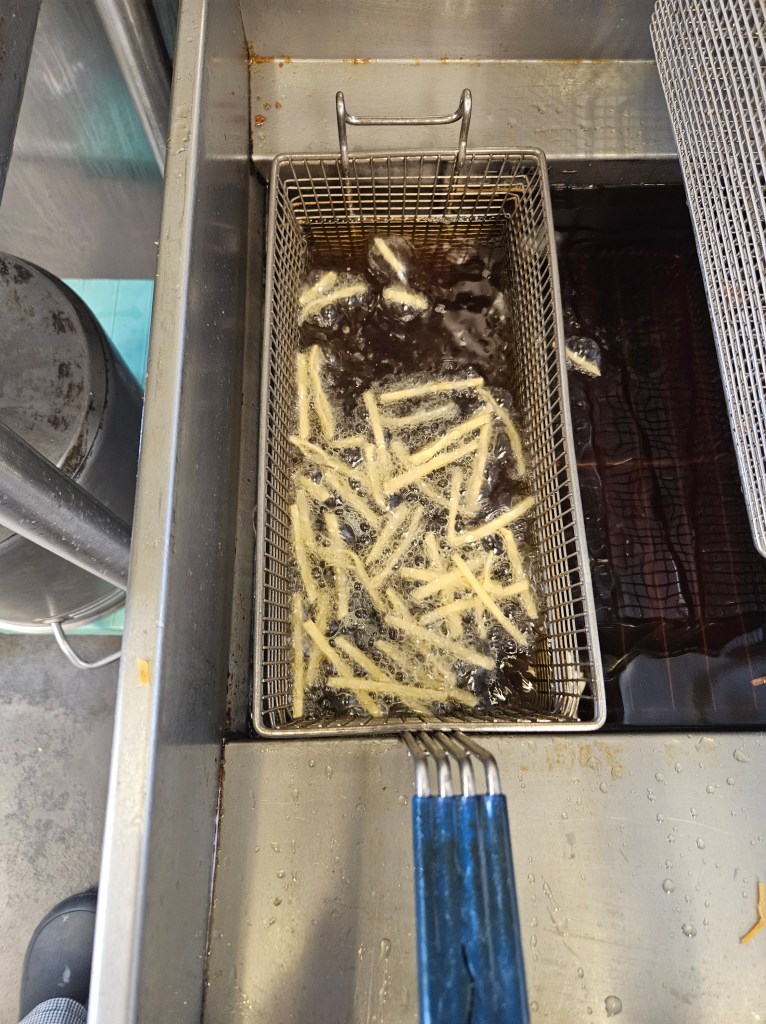
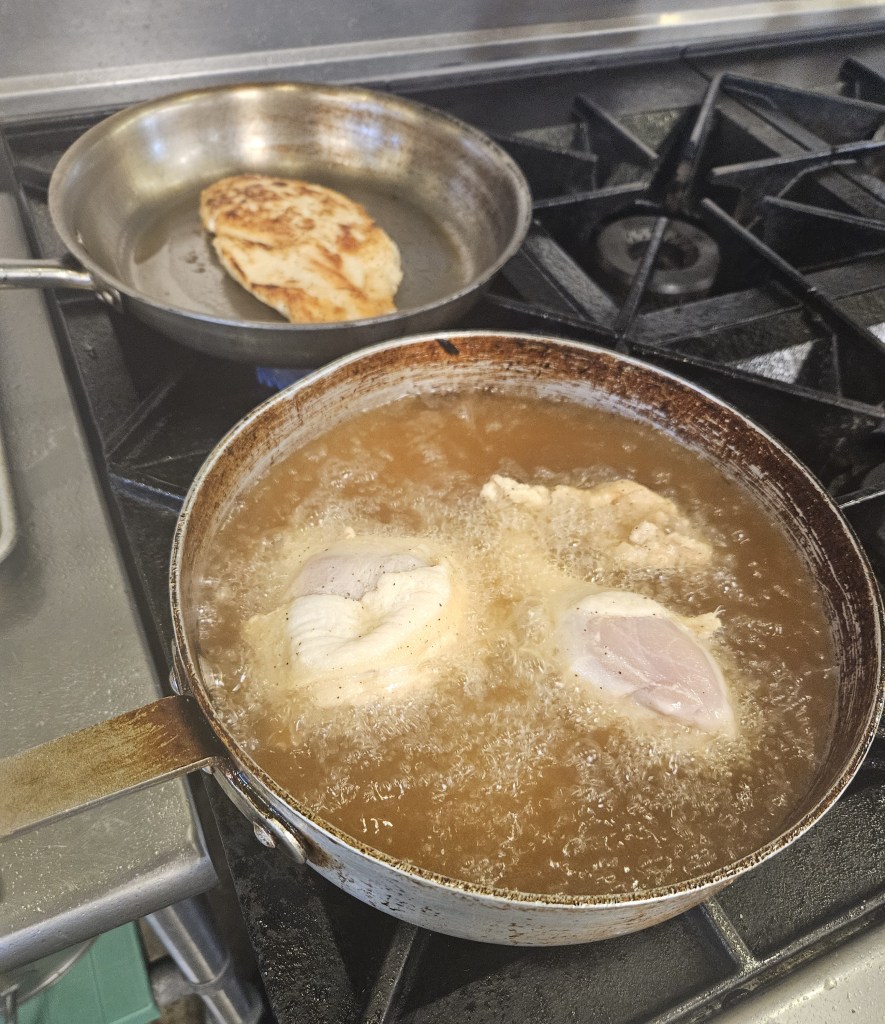
Chef’s demo of cooking chicken, bouncing between a pan-fry (just pulled), a sauteed breast, a grilled breast, and more pieces in the deep fryer (not pictured, on the other side of the classroom).

Quick aside on potatoes: I did great this week with knife cuts. 10/10 for the first time! I practiced a lot over the weekend and applied a few tricks Chef recommended for my height. Annoyingly, commercial kitchens are designed for “people” (read: MEN) who are about 5’5” to 6’3” (-ish). At 5’3”, I came just short (pun) of being able to apply proper cutting technique at commercial kitchen prep tables. Chef said I may never achieve perfection (what a relief!) but could get very close, with practice and a few adjustments. 

At home, I stopped eating the potatoes around early Sunday. I tried so hard, but I just couldn’t stomach any more. Growing up, wasting food was a sin, and I struggled with the idea that learning a skill was not the same as throwing away a perfectly good potato. I must have forced more than two bags of potatoes on me and my partner over the past few weeks, in order to practice my knife cuts. I made mashed potatoes, colcannon, shepherd’s pie, and more mash before just calling it. I threw away about four potatoes total the weekend before class, so my salvage numbers are still okay overall. I loathe waste, but I’m only human. Combine that with more egg-flipping practice and, good God, am I sick of potatoes and eggs.

Back to class. My knife cuts were going well when the chickens arrived. Oh. My. God. My classmates and I were stunned. The birds were huge. We now had less time than our classmates and double the meat. I got started and did okay with the little wings and drumettes, which seem to stay the same size no matter how busty the birds get. The thighs were tough to dislocate, and Chef had to come around and ask why I was struggling so much. He lifted the whole bird and snapped the leg joints for me. I managed to keep the oyster meat intact (a sweet little tidbit about the size of a quarter, located between the thigh and bone, that should always come with the thigh). The way I had to dig for the wishbone was borderline obscene. One of my classmates called me over to look at his bird, and asked about where to separate the thigh bone. He had cut his chicken differently than me, and we both struggled to find the correct edge of bone. I guessed and told him if I was wrong, I owed him a Coke. He asked for Pepsi instead. (I was, in fact, quite wrong and honored my bargain with a cold Pepsi delivered to him the next class).

When I finally cut the breasts away, they were the size of my head.  Chef said that the four of us with the dinosaur breasts could cut them in half for our purposes. Double shit. I rarely did that at home because I usually have smaller chickens. I gave it a try and came out with one still-pretty-substantial breast and one measly little a-bit-more-than-a-tenderloin. Speaking of which, I have a new respect for the humble little tender. She pulls away from the breast without need of a knife, almost as if to say: “I am ready for the fryer! Eat me and enjoy! There is no shame in loving the chicken tender!” So, with two breasts cut to a more reasonable size, and my two sad little almost-breasts, plus legs and thighs, I dove into cooking.

First was a saute, since my tablemate was already pan-frying. For safety reasons, Chef wanted only one pan-fry at a stove, as there is so much hot oil popping. I used one of my reasonable breasts and did okay. The stove is so powerful that I backed off a little on the heat, so the feedback that I had weak color didn’t come as a surprise. Then, I screwed up. I lost track of the purpose of the good breast (in my defense, I was downright swimming in breasts) and breaded it. NOT what I was supposed to do for grilling. What’s done is done, so I threw that one on to another saute (just to avoid more waste). While my original sauteed chicken was resting, I then had another going, plus I needed to start my pan-fry. While the oil heated up, I finished cooking my fuck-up saute and ran to Chef to grade my correct saute. My heat was a little too low, so my color was shy of golden. Seasoning on point. Success! I ran back to my station to pull my fuck-up saute to rest, and check the pan-fry oil. 

My sauteed chicken breast needed higher heat, which would have resulted in a better color. Because of my temperature error, I also left her cooking her too long. She was almost overcooked, and definitely veering to dry.
A very delicious but incorrectly prepared breaded sauteed breast in the back. My pan-fried chicken going strong. Bonus tenderloins frying from a classmate who wanted a snack, since we weren’t being graded on the tenders that day.

We use an infrared thermometer to check the heat of the oil for a pan-fry, which should be about 350 degrees F. There are other tricks to test it (a chopstick, bread crumbs, the corner of whatever you’re cooking), but these days, an infrared thermometer is so inexpensive and accurate, Chef says its reasonable to just depend on those. Fewer dishes or “stuff” around the stove. I got the pan-fry going and then Chef declared: “Twenty minutes left!”  BETRAYAL! I still had to grill and deep fry. 

I kept telling myself not to freak out, that I juggled dishes all the time at home. My pan-fried pieces were stubbornly not moving to 155 degrees, at which point I could pull them to rest. I ran to the grill and asked my tablemate for help. He saw me flour the thin little breast and reminded me there was no breading on the grill (why was I so obsessed with flour today?). I shook it off and threw it on the grill. Fuck. Forgot to oil it. My tablemate once again came to rescue and oiled the grill for me while I held my sad little chicken in the air. I ran to check my pan-fry, which was ready to go. I pulled those pieces to rest, then ran to the deep fryer. One student already had something in, but was gracious enough to move his basket over so I could add mine. Boom! Leg and thigh going in the deep fryer. 

I ran back to the pan-fried pieces resting and hovered my hand over them to feel how hot they were. Still pretty warm, so I didn’t even need to take their temperature. Back to the grill. Good grill marks on one side, so I flipped her. I realized that this piece was so slim, she was rapidly shrinking. I made a mental apology to the well-endowed chicken that died for my grade, and decided the grilled breast was on her own. I brought the now-rested pan-fried pieces to Chef, who praised the cook. I was one of the only ones with those massive birds that cooked them all the way through. I checked on my deep fry which was still looking light, ran to the grill, and pulled my sad girl off to rest. Then, I took a breath for the first time in about 17 minutes.

My beautiful pan-fried darlings.

Chef and I laughed over my paltry grilled breast. “What happened here?” he said. “Well, sir, the butcher and the cook weren’t on the same page. It’s not the chicken’s fault. She was the victim in all of this.” At least I got a chuckle. She was, not surprisingly, wildly overdone. And highly peppered, which I barely even remember doing. One of my lowest scores to date in the class, but at least I wasn’t surprised by it.

I pulled my deep fried pieces with seconds left. Kindly, Chef looked at them and declared them done appropriately. He was either able to tell just by the color or texture, or he was so exasperated with us all that he didn’t want to cut into another piece of chicken. Perhaps it was a little of both. Regardless, I was grateful for the relief so I could move onto dishes.

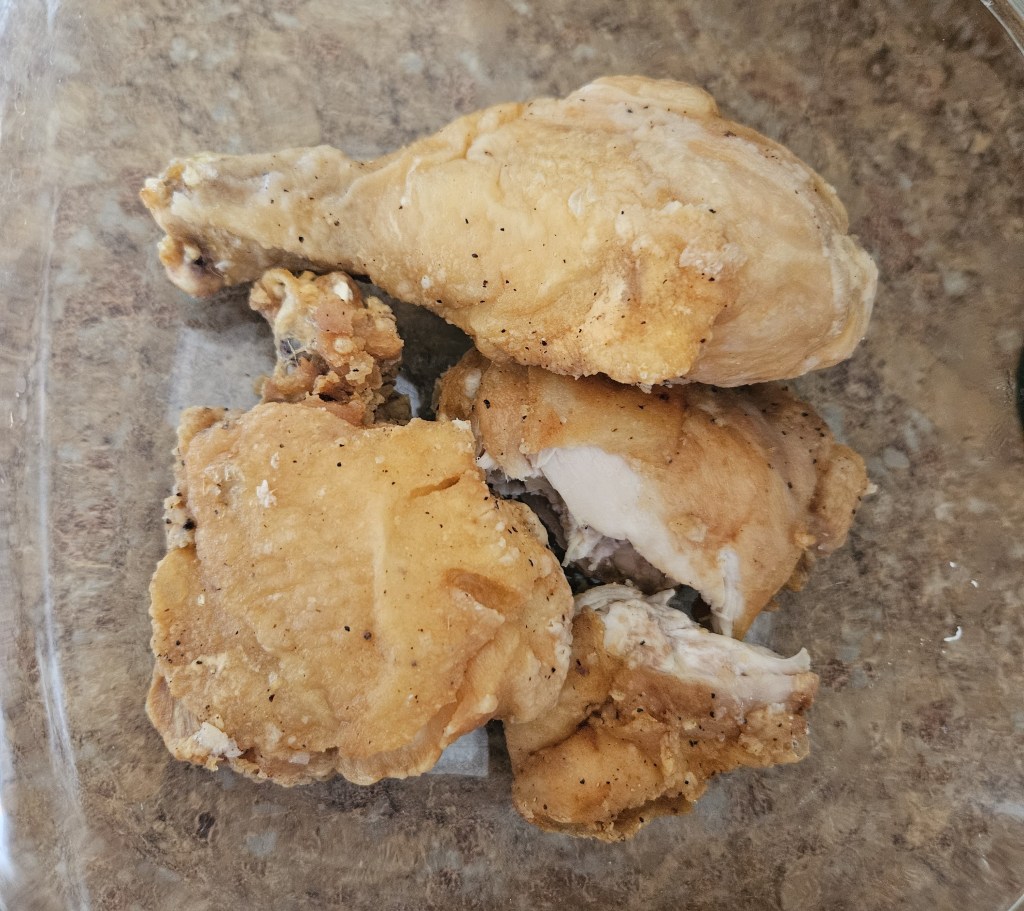
My pan-fried and deep-fried pieces. I was proud that they are almost indistinguishable, meaning I nailed the oil temperature and cook time on the pan-fry. Disregard bites taken out from starving culinary student.

Getting more comfortable in the kitchen means I’m able to move a little bit faster. It feels pathetically infinitesimal, but it’s something. I may be the slowest cook, the slowest chopper, the slowest cleaner, but I don’t stop. It’s all I can offer my peers. Once I’m done cooking, I run (metaphorically, since running is highly unsafe in kitchens) to grab dishes, spot check issues, and communicate loudly with my classmates. 

Being in culinary school has shown a spotlight on many bad habits and flaws I have, not just in the kitchen but as a person. I’m starting to see ways in which my actions don’t align with my values or intent. It’s humbling and painful, but I’m thankful for the opportunity to see myself in these new ways. Too often, we get complacent and insular. We surround ourselves with people just like ourselves and don’t see those rough edges that could use some refining. One thing I’ve noticed is how much I resist help. I want to do it myself, handle it myself, take the credit myself. I want to be fully self-reliant and never in need. 

Reality check: I could not have gotten through this class without the courtesy and assistance of my peers. Gentle reminders, extra care, and physical support are all around me. It’s humbling how much my spirit rebelled against it. While I finished my chicken, dishes around me magically disappeared. Students to whom I gave incorrect information laughed the errors off. I’m surrounded by grace, patience, and humor with a majority of people who are half my age. Learning how to accept help has been one of the most difficult parts of the classroom so far. I never expected it. However, it’s also shifted my perspective on being helpful. I see now how vulnerable it is to need assistance. The best help, at least in the kitchen, is swift and unflinching, with no regard for tally or “pay back.” The general consensus is that it will all come around again.

Week Two – Day Two: Eggs Made Me Cry

“Don’t fear failure. — Not failure, but low aim, is the crime. In great attempts it is glorious even to fail.” – Bruce Lee

The quote above from Bruce Lee may seem a little intense for an introductory culinary class practicing eggs over easy. I can assure you, failure is painful in all its capacities. When it is something you care about, something you love, something you want, all failure hurts. And when the failure is small and persistent, there is an extra layer of shame. “This is easy,” I kept screaming to myself. “Just DO it! Everyone is doing it! This simple, simple thing!” What inevitably happens once I start talking to myself like that is continued failure. Despite my internal desire to veer into this self-flagellation, it has never ever worked to correct my actions. The same was true in class.

We began the day with brown stock. The difference between white and brown stock is that white stock places bones (usually chicken or fish) directly into boiling water, while brown stock roasts the bones (usually veal or beef) first. If I thought 20 pots of white stock was incredible, the smell of roasting veal bones was another level. The air felt rich but still light. Brown stock also sautes the mirepoix first, which creates a delicious caramelization to the vegetables.

My table’s brown stock was literally golden.

We prepared one pot as a table, which made me nervous. But, the students in this class continue to impress me with their positivity and professionalism. Working together with two strangers around steaming bones and sharp knives was shockingly smooth. The kitchen is a loud place, where communication matters above all else. 

“I’ll grab our bones, you get started on the herb sachet, and you prep the pot on the stove. Is that okay?” 

“Mary, can you check my mirepoix?” 

“Behind!” 

“Sharp, corner!” 

“Hot pan!” 

“Someone’s is boiling over! Table Three? I’m turning it down!”

Still riding high from last class’s encouragement from Chef, and buoyed by a great start to the class, I was excited. I had also practiced eggs over easy and over medium all weekend. My partner loved over easy eggs, so I felt like a star bringing plate after plate for breakfast and dinner, watching them cut into steamy whites and seeing that perfect, custardy yolk spill out. I was here to nail it.

As Chef began his demo, my heart started to flutter. Oh, we’re doing two eggs?  Hmm, okay, that shouldn’t be too bad. And they have to be flipped. Okay, I knew that. I practiced. But he seems to be going into a lot of depth explaining what to do when the eggs break (“Flip over the stove, not the floor. The burners are easier to clean than the floor.”)  He also asked for two people to a stove, if possible. That day, I was the only table of three. My classmates encouraged me to take the third burner, that they would make space for me, but I got flustered. Chef then told me to just use his station. His station. Where Chef cooked all his perfect eggs. With the camera directly above me. Broadcasting my eggs to every screen in the classroom. I will fully admit, this moment is when I started to sweat.

In gathering my tools, I realized my second mistake (the first being only practicing with one egg). I practiced using my home pan. I had forgotten my school pan in my locker and figured it was no big deal. It was, in fact, quite a big deal. My school pan was thicker, newer, and of better quality. It weighed about three times as much as my home pan. Double shit. But there was nothing I could do about it now. I warmed up my pan on the massive burner, added some oil, and began.

Why so many eggs on the syllabus?  Eggs are deceptively difficult to make correctly and consistently. They are all about temperature control and attention to detail. Chef expected our eggs to be cooked evenly (not one yolk different from the other), with absolutely no browning, and as few bubbles as possible. I decided to aim high with what I knew and go for the hardest one first: eggs over easy. I started well. My temperature was good. The spatula felt like an extension of my hand as I delicately pushed the edges from the side, loosening up the whites so I could swirl them. As they started to set, I knew this was the moment. One flip attempt and my wrist froze up, so they barely even hopped in the pan. I looked at the clock (mistake) and realized I was getting behind schedule. The other terrible thing about my location was that Chef was seated to my left reviewing the eggs. That meant Every. Single. Student. walked by me with their egg plate – really driving home how slowly I was cooking. I decided to just go big and jerked my wrist. The eggs hit the edge and yolk splattered everywhere. Ok, I prepped my other eggs, so I had two more ready to go. I wiped my pan, oiled and started again. Perfect cook again, destroyed on the flip. Great. I went for a third time and about 75% of my eggs landed well, the other 25% flopped sadly on top of themselves. I quickly adjusted them with my spatula, seasoned them, and slid them onto a plate. Finally! My work was good, but my whites were not as set as they should be. I’LL TAKE IT!

I had a new problem, though. I had prepped three sets of eggs and used them all. That meant while my classmates still cooked away, I needed to run to the fridge, grab more eggs, crack them into their respective containers, wash my hands, and return to the stove. Precious minutes slipped away. The students and the eggs just kept coming. A few made encouraging small talk with me while they waited in line for Chef’s review. I just kept breaking them. By the time I came to my final set of eggs, I gave up. I tried a flip, failed, and then quickly broke them up to cook as over hard. Most of the students were completely done and moved onto cleaning. One joked with me about watching me flip and cheering for me. (Remember, I’m also literally being filmed while cooking). I plated my sad little eggs over hard, which were okay but not quite up to snuff (over hard eggs need to have fully cooked yolk set hard with no bright yellow, of which I had a few spots). Chef was generous: “If you don’t eat eggs over hard, it’s difficult to cook them. And who wants over hard anyway?” Despite his politeness, I was crushed. I still had a huge mess to clean up, while my peers had moved on from cleaning their personal dishes to the classroom. 

Each day, we are responsible as a class for scrubbing and sanitizing the kitchen lab, resetting it to its original state. The different tables have tasks assigned to them that rotate each week.

Each student is responsible for cleaning their own dishes. Then, we clean all other dishes as a group. Here is the dish pit looking flawless before class begins.

As I started cleaning my own dishes, I realized I was also now not helping my tablemates as they performed our group duties. I felt like such a loser. Oldest, slowest, my first zero in the class since I never got to over medium eggs, and I can’t even keep up on dishes. A final blow was when I emerged from the dish pit to see a fellow student cleaning my eggs off the burner (my responsibility). When I went to talk to her, she told me I had left a burner on – a huge safety issue. She was kind but her reprimand to “Be more careful” hurt. She could have told on me to Chef (and been right to) and I would have lost more points for the day. She told me quietly, just between us. It was a classy move on her part, but I was lower than low, disappointed in myself in a way I hadn’t experienced in years. My optimism was gone. As we finished cleaning, and Chef gave general notes for the day, I felt my chest tighten. He explained what the assignments were for next week and what to expect in the lab. I tried to focus. I clung desperately to the threads of my growth mindset. “You’re not going to be perfect every day.”  It wasn’t that I was trying to be perfect at all. I realized I was comfortable with learning as long as it mean I did “okay” to “well.” Today had been bad. I did poorly and was ashamed of it. More than the grades itself, I felt like a burden to my peers. I had not done my part. I had even put them in danger. 

I made it to the car before the tears fell, which was perhaps my only win of the day. As I drove home, I thought how stupid it was to cry over eggs. But, here I was. Last place, with yolk stuck to my clothes, my fingers burning, and feeling completely ancient. I texted some friends when I got home and received nothing but positive encouragement. It took about a day or two to recover. I was embarrassed, but I knew that recovery was what mattered. Not every dish required that cursed flip. Next week was chicken. Chicken is kind, right?

Week Two – Day One: Sensory Heaven

“Rather than waste your time being stressed over making the right decision, make the decision right.” – Dr. Ellen Langer

I walked into the lecture portion of class late on the first day of Week Two. Exactly how I did not want to start. The “good student” in me seethed at my time management skills and also how dare I trust a lock? Culinary students keep personal items and spare tools in lockers nearby our classrooms. Only the essential tools needed for the day are allowed in the kitchen lab.  Feeling 15 again in the worst possible way, I struggled with my combination, then the lock simply refused to close at all. Couple that with getting immediately lost in a relatively small building, and I felt pretty shitty about the day already.
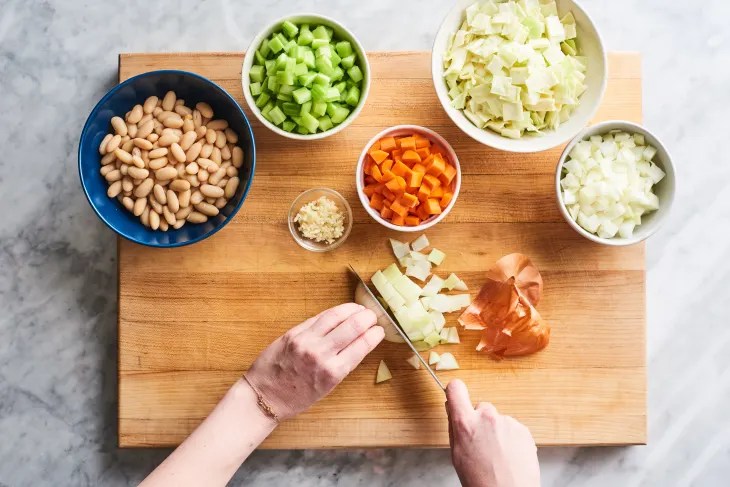
The lecture portion of class meets at 8:00am for an hour and a half. I was able to catch my breath and cool my sweating body, but I was so mad at myself. A memory of a former supervisor floated across my mind. I had been three minutes late to a meeting and was stunned at her reprimand. “Three minutes is a lot,” she said. “I take our time together seriously. I am prepared for our conversation and you aren’t.” I remember thinking, “Good grief, lighten up.” As I sat in class that day, though, I saw that moment in a new light. She was right. One-on-one time with an expert in a field is precious. One-on-one time with any human is precious. I am taking time away from my life to build a new life here. To show up also means to show up ready.

The idea of mise en place was the topic of the lecture that day. We learned about having “everything in its place” to mean not only a tidy and efficient space with all the correct tools, but also the right mindset for the work at hand. To appear at the correct time, with the correct headspace. Not necessarily ignoring the other critical elements of life that weigh in the mind and heart, but asking them to briefly step down. “I will take care of your needs, but first, I must work.” It comforted me. I hadn’t shown up well that day, but I had another day to try again. And the knowledge of mise en place was a tool in and of itself. Planning and preparation. Giving the hours you must spend in a certain way the attention it demands. Maybe not demands, but deserves. As I headed into the lab portion of the class later that day, my spirits were much higher. Today was a day for which I could still show up well. 

Example of “Mise en place” from The Kitchn (Credit: Photo: Joe Lingeman; Food Styling: Olwen Phillips; Article Link)

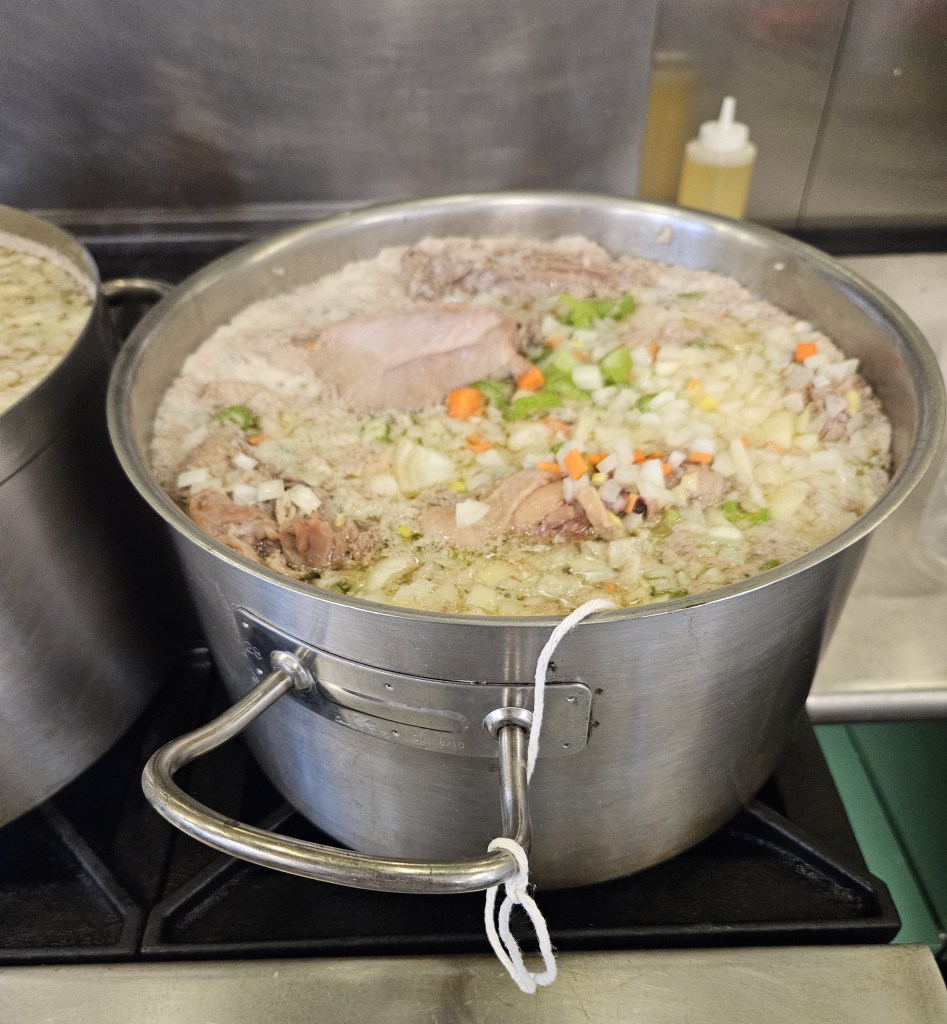
Indeed, it was white stock day – simple, essential, delicious. Each student received 8 pounds of chicken bones. We prepared our mirepoix by roughly chopping onions, celery, and carrots. I loved learning about mirepoix: the base components for a variety of dishes. There are also different mirepoix for different cultures. In French cooking (on which most American culinary education is based), the ratio is two parts onion, one part celery, and one part carrot. The “holy trinity” of Cajun and Creole cooking is a mirepoix of onion, celery, and  green pepper. The Spanish and Latin sofrito is a mirepoix of onion, tomato, and garlic. Asian cuisine uses a mirepoix of scallions, garlic, and ginger. While the actual name mirepoix is specific only to French cuisine, it’s fascinating that we all approach cooking with such connected ideas: start with a base that your family knows, loves, and grows well around you, then work your way up to more complex dishes. It’s beautiful.

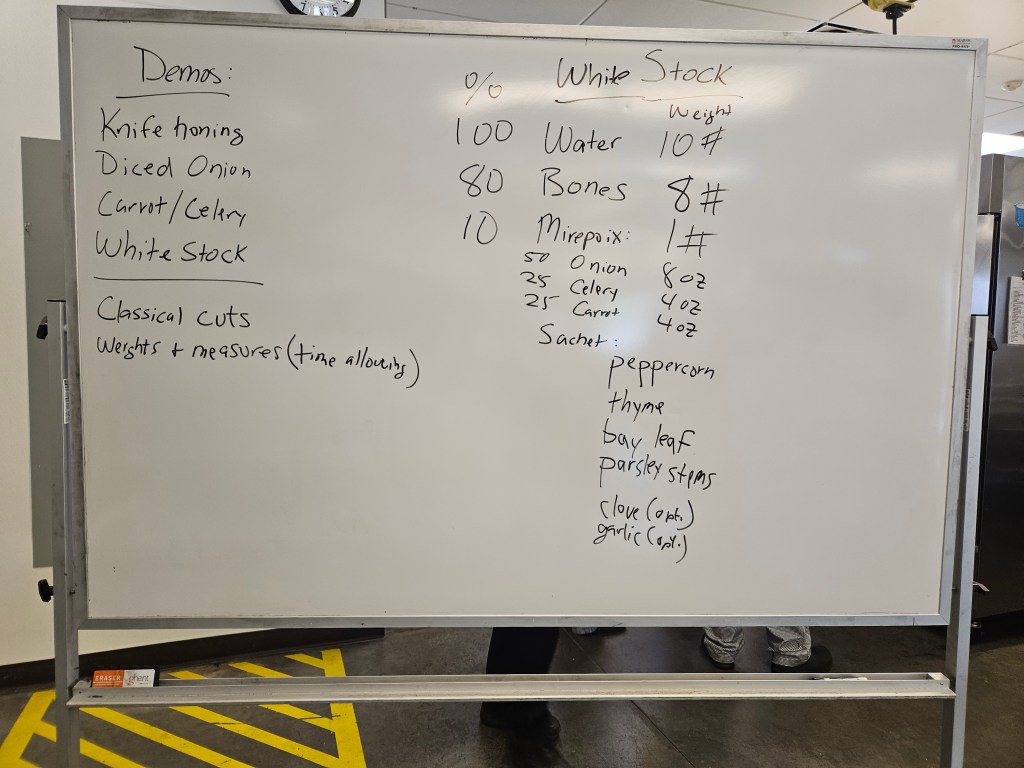
Chef will sometimes lay out the plan for the day on a rolling white board. He quizzed us on the ratios of mirepoix, including the ounces needed for each ingredient in relation to bones. The general rule is one pound of mirepoix for every eight pounds of bones.

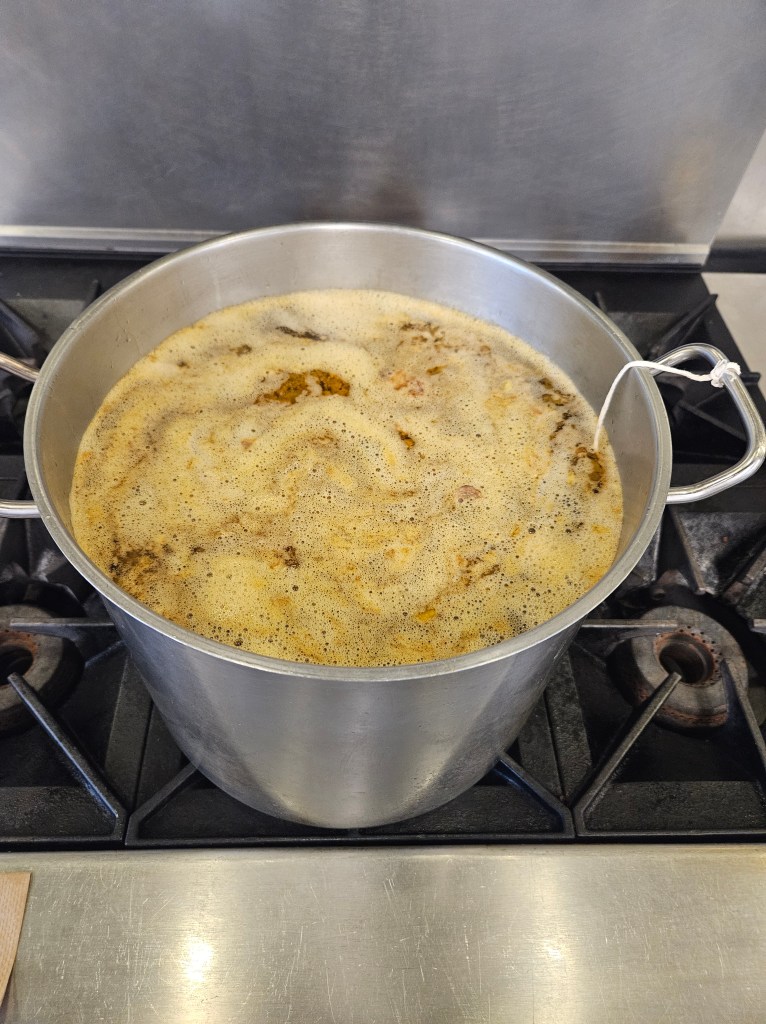
After simmering the chicken carcasses, skimming the fat, and adding the mirepoix took about an hour.  Roughly 20 stockpots surrounded us, brimming with incredible aromas. It was absolute heaven. The steam from both sides of the room enveloped us. It was an amazing moment. We have all experienced the delicious joy of inhaling something on the stove. To be immersed in this way, letting pots full of all our efforts waft over each pore and infusing our very breath. I will never forget it.

My beautiful white stock!

We also tackled more knife cuts that day. I was ready. Instead of pretending to be 22 again, I brought my reading glasses this time. I also asked Chef for a red cutting board instead of the usual white ones. Now, I could actually fucking see. My cuts were still off, but better. Chef complimented my technique and encouraged me to increase my production. Last week, I had tried to keep up with my tablemates and went too quickly. He had encouraged me to slow down and really look at my cuts. Now that I had done so, he wanted more. “I can assess you better with a mix. Show me everything, not just your best.” I felt a twinge in my little overachieving heart, but I knew he was right. To correct mistakes, I had to show him my mistakes. I hated it. His feedback was constructive and kind (a treasured skill in a teacher). Instead of scolding me for cherry-picking my best and finest cuts, he asked to see more of my ability. Phrased in this way, I felt buoyed and ready to show him more of my flaws. He also complimented me on the fact that I was self-correcting, which was a good skill to have in the kitchen. It was a nice way to attribute my slightly neurotic selection of cuts to present. Maybe, just actually fucking maybe, I could do these things. Maybe I could do this class. Maybe I could finish and finish well. Shit, our next class was eggs and I loved eggs!

Week One – Day Two: Potato Whittling

“We’re not dying at 50. What are we doing for the next 40 years? Going to boohoo about not being 25?”- Stacy London

My community has been supportive and enthusiastic about my decision to take a break from work for a few months and take cooking classes. I received cheers from everyone I told, which tells me I’ve done well in choosing my chosen family. The conversation falters a bit when the next question inevitably arises: “And then what are you going to do?”  It’s a well-meaning ask, and logical given the circumstances. Only my closest friends knew how intense my cooking hobby had become over the past few years. Outer circles saw the occasional food or restaurant post, but that’s common fodder for most of us on social media. It’s not that I objected to the question. It’s the awkwardness that followed when I said, “I don’t….really know. I don’t know?” I found myself getting flustered and being quick to assure them that I would probably just go back to my regular work at the end of the summer. A handful of them couldn’t stop a flash of relief from dancing across their eyes. Sometimes a slightly crinkled brow would smooth. There isn’t anything wrong with this response. It makes me a little sad. I see it not as a flaw on my friends’ part, but rather a normal reaction from all of us being indoctrinated into a society obsessed with labor. It made sense to take time off for a vacation or to go to school with a degree in mind or recuperate from an illness – all endeavors with a tangible goal and an end date. Some were just puzzled by a three-month delving into…what, exactly? But all were ultimately supportive.

Most of my community lit up right away when I didn’t have an answer to that question. “How exciting!” “Perfect!” “No need to figure it out now!” Their words lifted my spirits before I started classes. During the hardest moments, they were a balm to bruised ego and discouraged heart. Culinary school – even one as accessible as mine – is not for the weak. 

Nell Painter’s book, “Old in Art School,” has been a beacon to me during this adventure. She speaks of her motivation to step away from a prestigious career as a historian to enroll in art school:

“Why I would want to go to art school was another . Answer: The pursuit of pleasure. Concentrating on what I could see gave me intense pleasure, and seeing what I could make with my own hand and according to my own eye was even more satisfying.”

The first day of class was filled with torrents of information via lecture. My back ached from sitting on the terrible metal stools but standing at attention was also terrible. I thought there was no way I could finish this summer. It’s a miracle what motivated action does to the body. I did walk away from the second week with throbbing feet and a sore back, but the pain was nothing like week one. Cooking was actually easier on my body.

And my mind. To set upon a task, and one so close to my heart, fueled something in me.

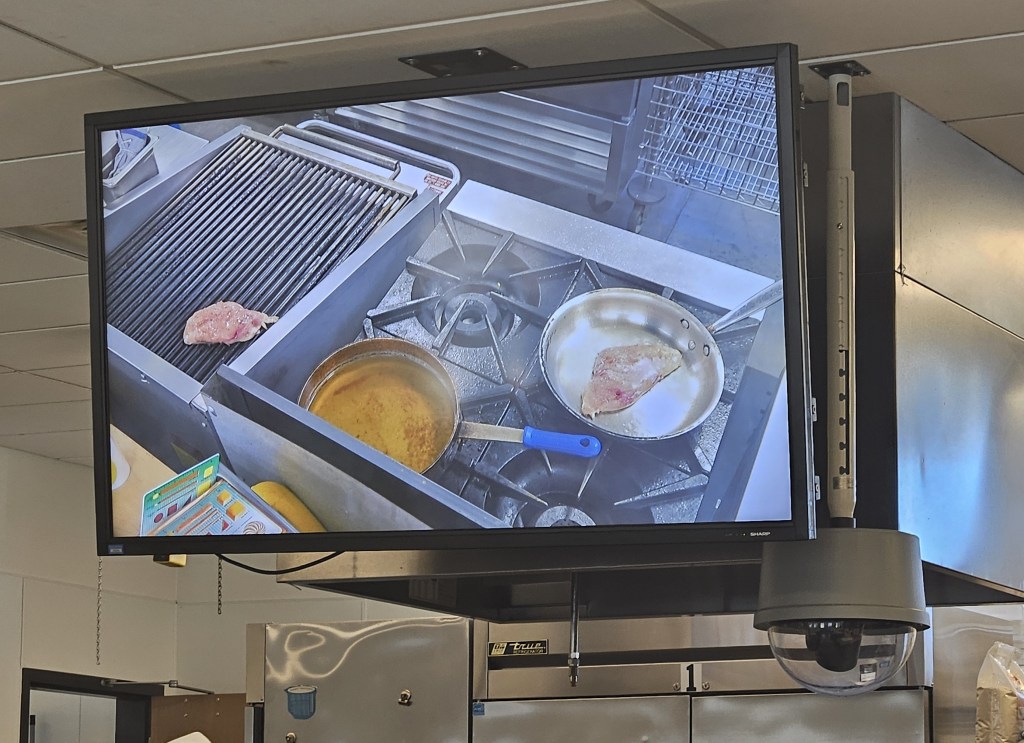
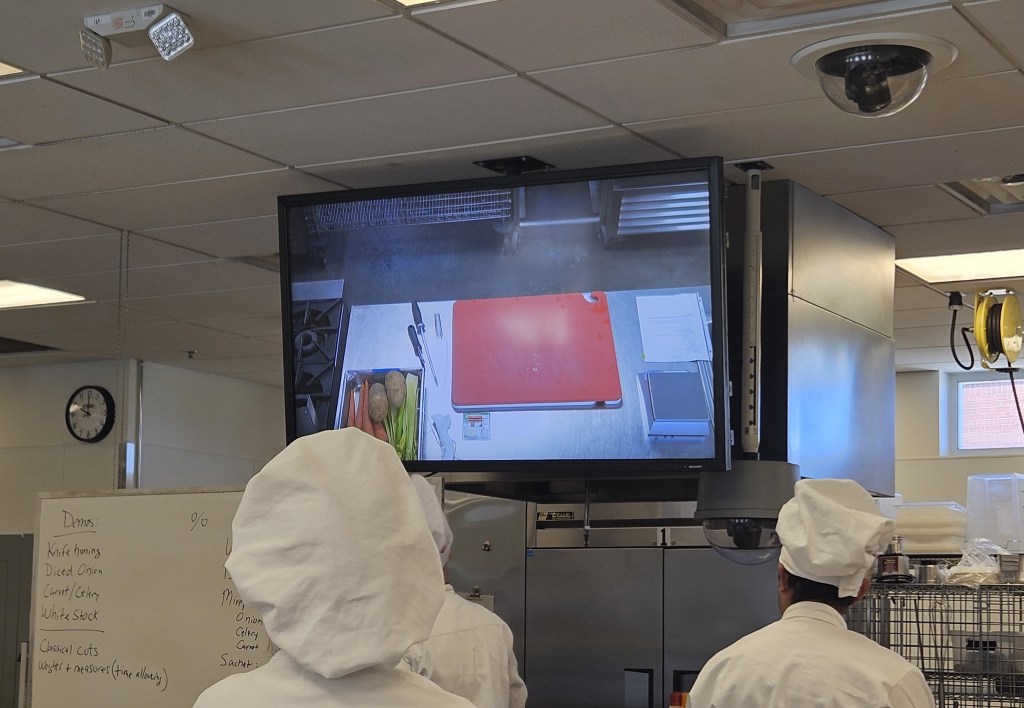
Chef works at the front of the classroom, facing us. A camera directly above records him and monitors scattered throughout the classroom ensure we all have a good view.

The second day, we began knife cuts. Classical knife cuts require physical stamina to consistently hold your knife correctly, and a sharp eye to angles and lengths. While we are allowed to use a guide (the blessed Mercer ruler), Chef encouraged us to try and cut using our own sight, then measure (instead of the other way around). Squaring off a potato seems simple enough. Ensuring the knife is aligned with a steady cutting board, simply apply pressure and rock the blade forward and through. Boom! A beautiful straight line. Rotate the potato and slice (do not chop) again, rotate and again, finish the sides, and then lose the ends. What remains should be a perfect square of starch. Except…it never quite works like that. My perfect squares somehow always had one wonky angle. Each time I tried to shave a bit off and remedy it, another angle seemed to also slide away from 90 degrees. Okay, take off a bigger piece. But now the ends are off, too. Trim and trim. Suddenly my perfect starter square has shrunk to half its size. Shit, well I might as well dive in and at least get a few cubes out of this. The issue is that without a solid starting square, cuts and cubes will taper and angle in even more severe ways. The fluorescent lights, the white of the cutting board, and the pale starch shrinking into tinier and tinier cubes was brutal. My eyes watered and I left class with a pounding headache. 
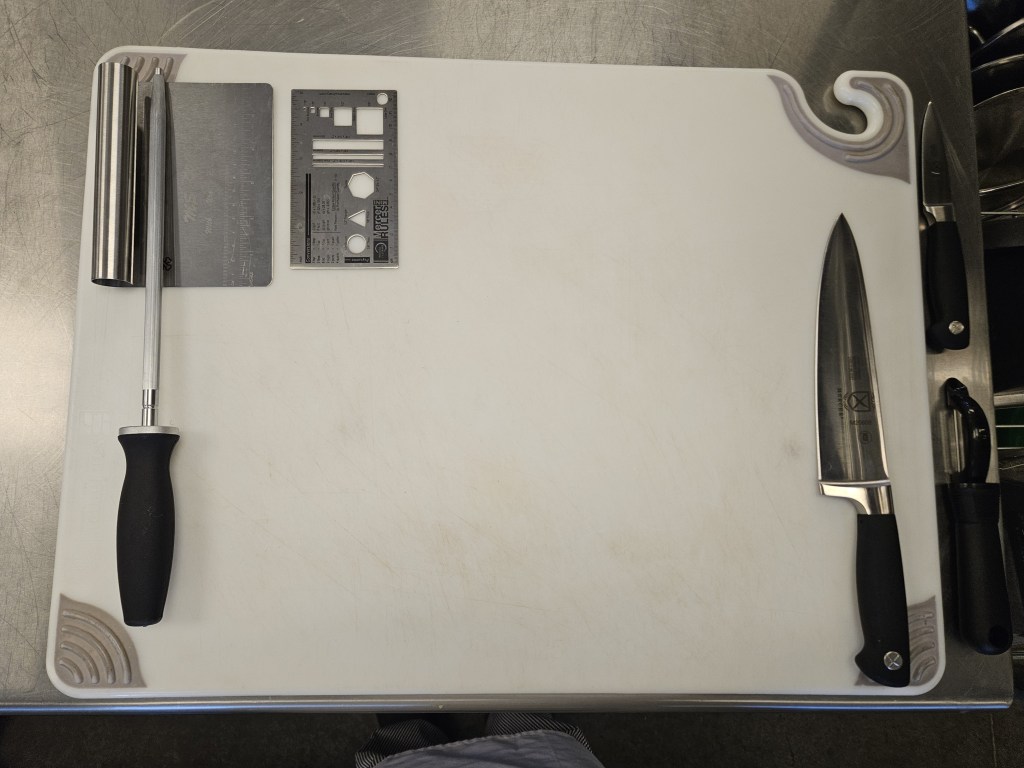
My station set up. I share a table with two other students.

That night, I ate Goldfish crackers and whiskey for dinner. Before this summer, I had always used frozen dinners sparingly but I realized that I needed help on class days. My wonderful partner agreed to cook for me those nights, or to simply take us out and ensure food went in my mouth. Cooking was usually my respite after a difficult day. I was not used to it taking all of my energy – both physical and emotional. This week was hard and terrifying. But, I knew that starting is always the hardest part. I would at least try to cook something before I quit.