“Fear is a machine I’m learning to operate.” – Jacob Ward
The year I turned 40, I quit my job and enrolled in culinary school. The words in that order sound more dramatic than the reality of the situation. The job I left was in a field that loved me, though it wasn’t always mutual. I achieved moderate success, built several fulfilling professional friendships, and could pick up the work any time I want in the future. I’m lucky in that way.
I’m also lucky that I live near a community college with a prestigious culinary program. I’m paying a fraction of a fraction for an excellent education at a school without a French name. My instructors have incredible experience and knowledge, and a community college is by nature a warmer, more welcoming environment than other educational institutions. I’m also lucky that frugal living and a supportive partner mean that I can afford to simply not work for a few months. I see all of these privileges, these safety nets layered around me, and still…terror.
I almost didn’t walk into class the first day. I felt old and hot (the flushed kind, not the sexy kind). What was I doing there? I don’t even want to work in a restaurant. Am I stupid? Am I having a mid-life crisis? I’m too old to be pummeling myself in an academic setting again. I did the BA. I did the MA. I crashed and burned at the PhD. Haven’t I learned anything? I’m not fit for academia.
But culinary school is and isn’t “academia.” Sure, many things are familiar. There is an overly complicated portal for my classes that never seems to update properly. Syllabi have not changed much in structure, but certainly in length (22 pages?!) The same types of personalities show up in the classroom space. The fluorescent lights sear into my eyeballs and somehow through my eyelids. Every single chair seems designed by someone who has never sat in a chair. Mid-terms and finals, a scattering of quizzes, textbooks of the latest edition that are somehow still riddled with typos. The thrill of learning something new. A tidbit or a technique. A secret trick to writing or research. And yes, the “A-ha!” moments that are as potently addicting as drugs. Oh, I remember this place. And yet, where I’ve landed is also a totally different planet than my former classrooms of debate over marginalia.
Chef and Sous Chef are markedly more organized and professional than most teachers in my undergraduate past. My liberal arts memories consist of professors ranging from affably rumpled to bullies still present in my nightmares. Written work was acrobatic, and I spent a lot of my professional writing life trying to undo the bad habits I developed there. My culinary courses are regimented in logical progression, building on each tradition, technique, and skillset. The required uniforms are fit for purpose. Class is predictable, but challenging. The challenges feel surmountable, given the order of the class. In many ways, I feel like I’m back in my graduate program (Dance History and Criticism) where intense scholarly work balanced equally with intense physical work. I’m using my mind and my body again.
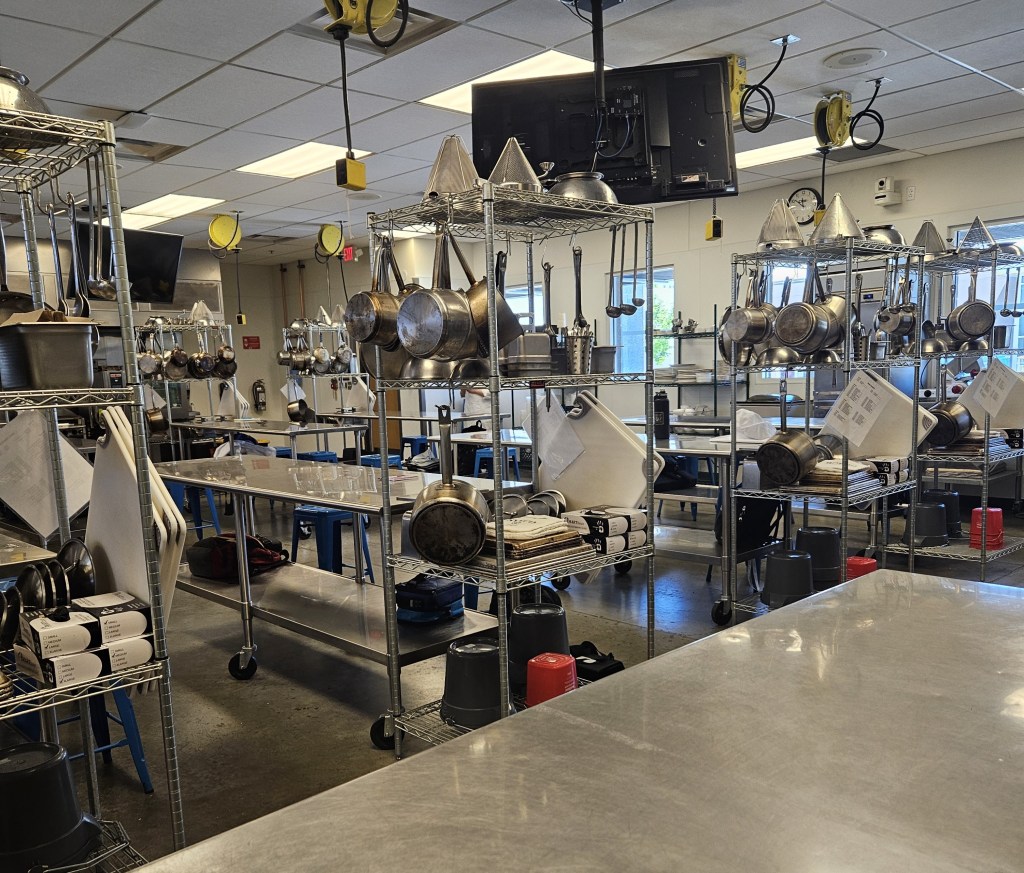
Culinary arts also attracts a different type of student. My age alone sets me apart from most of the others. Unlike general education classes which feel more like bonding over a shared prison sentence, our love of cooking unites us. There are fewer disruptions from students who are distracted or bored. Most people don’t talk over Chef. There is some cell phone use, but it is minimal. It’s both strange and refreshing to be in an educational space in which the other students are incredibly focused. Even in graduate school (which I enjoyed markedly more than undergraduate), the permeations of competition and prestige of teacher attention changes the dynamics of the classroom. While students do vye for the attention of Chef, the courtesy of a regimented brigade system, as well as intense safety precautions, prevent most disruptive behavior. More than that, the students are all desperate to learn. It’s a fascinating environment. Stripping the superficial layers away (papers, conferences, scholarships, awards), and leaving only the craft, my peers and I are ravenous for instruction. We want to know how and why, where a technique originated, why one and not the other.
But let’s get to the real stuff.
My uniform is a sensory nightmare. It is tight and loose in all the wrong places: taut across the chest as an unwelcome reminder that “unisex” really means “male,” exorbitantly floppy pants that need a seven inch hem because that was the size big enough to cover my ass, a linen-type hat that holds my hair in place but scratches at my forehead so much that I have to rip it off during breaks to get some relief. The non-slip, ergonomic shoes are now my new favorites, but the rubber soles take getting used to. Hair needs to be tied and tucked, which is pleasant enough. One difficult rule is no watches and no jewelry of any kind (except a wedding band). So, my good luck charms and fidget aids are gone.
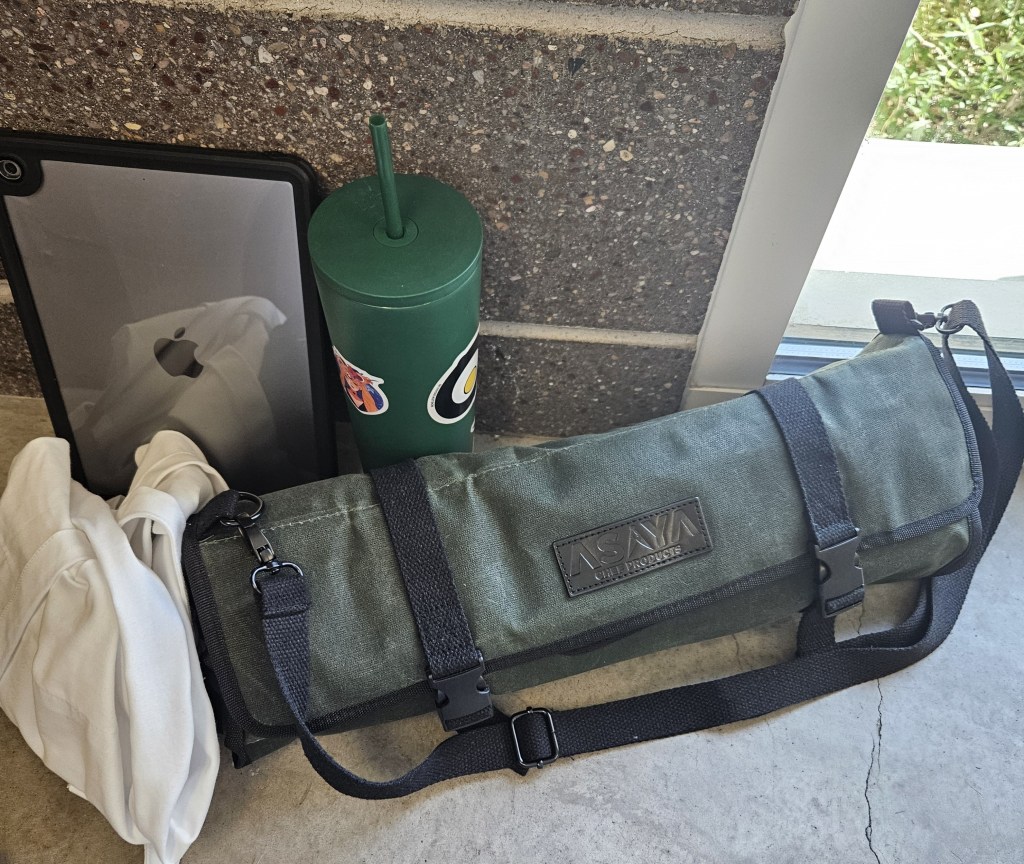
I guess this moment is a good time to mention my autism. Clothes can be prisons for me. The second I saw the uniform requirements, my heart sunk. The classes run from 8:00am to about 3:30pm. I was immediately worried that I wouldn’t get through the day. But, I wanted to try. I wanted this. And I didn’t want the uniform to be what kept me out. It may be what destroys me. But I didn’t want it to be the thing that kept me from starting.
The required knife kit is full of dreamy tools of which I became immediately enamored:
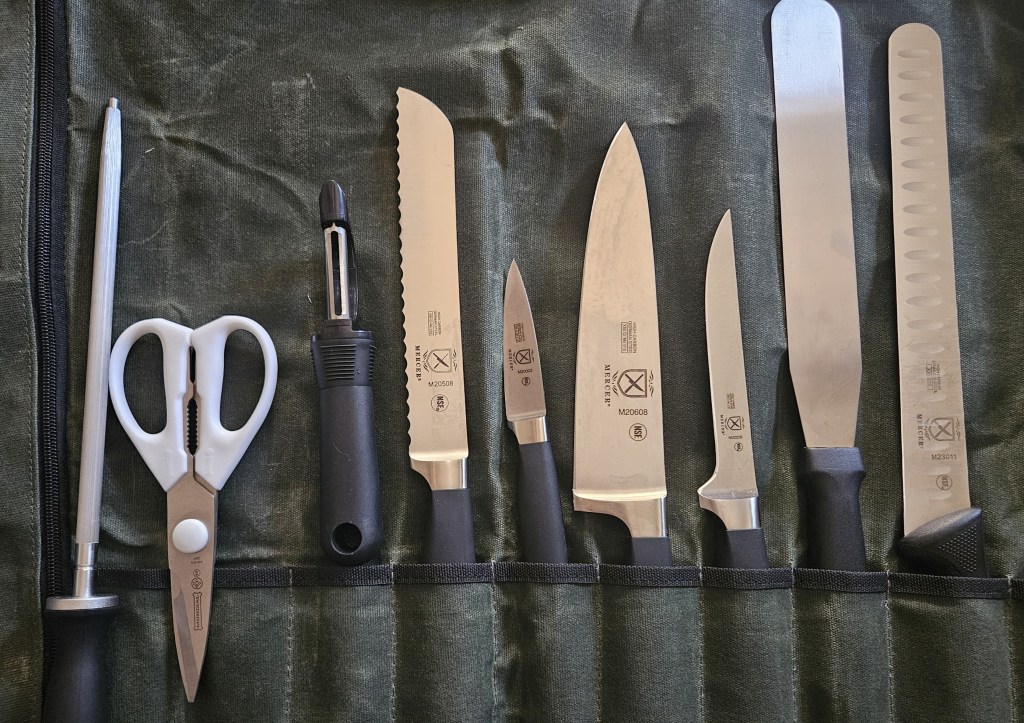
Additional tools seemed excessive on the syllabus, but proved to be invaluable. I’ll never work without a bench scraper again!

We are also required to have towels, an egg pan, spatulas, and mixing spoons. I spent about $600 overall for everything, but I also bought the optional extras. It’s really an investment into my own kitchen. Plus, buying kitchen supplies gives me the same high as buying school supplies did years ago. It felt like a nice tradition to continue.
 Tiger Tail Kitchen